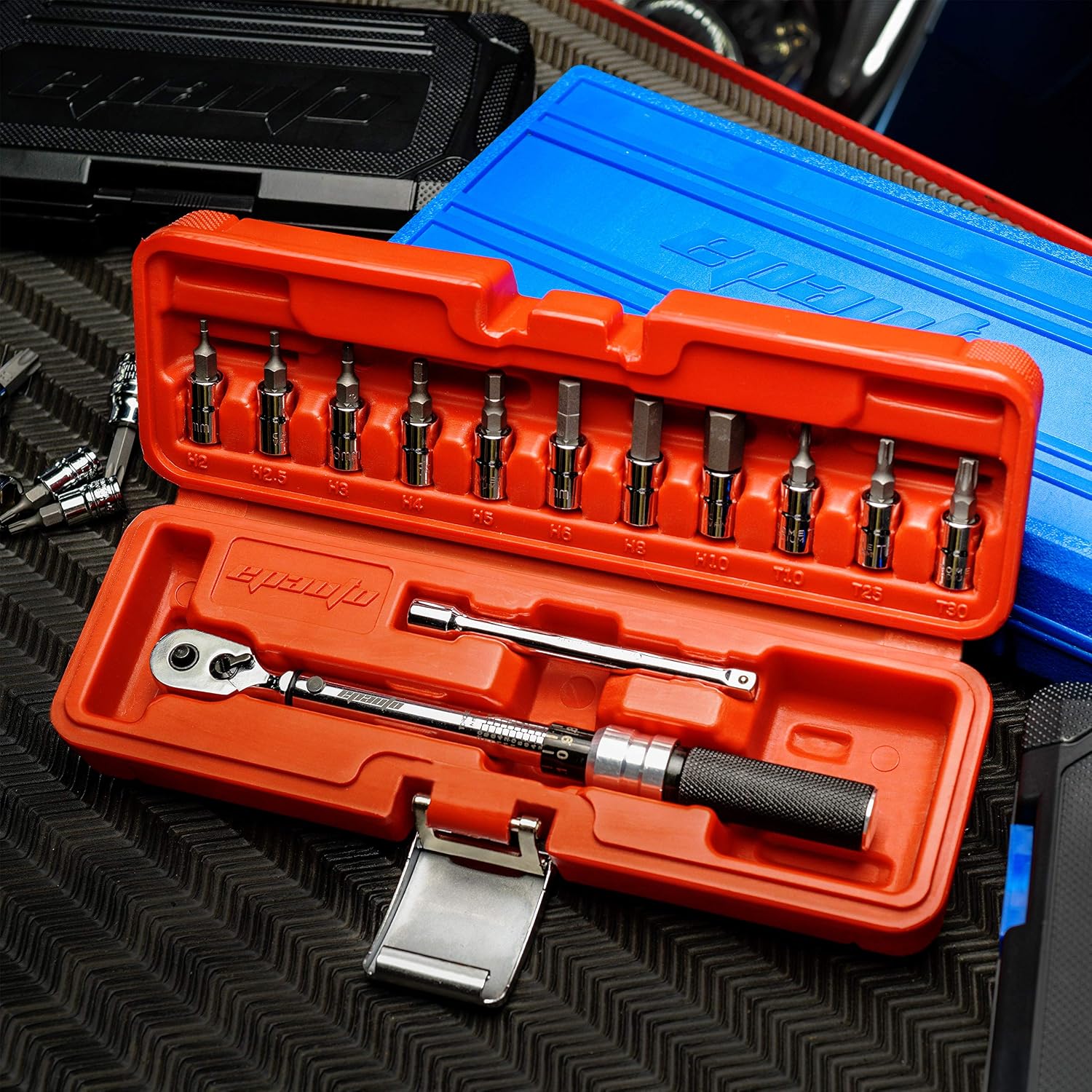
If you’ve ever overtightened a stem bolt and heard that sickening crack from a carbon handlebar — or stripped the threads on an aluminum seatpost clamp because you were guessing at “snug enough” — you already understand why a torque wrench matters. A torque wrench is simply a tool that lets you tighten a bolt to an exact amount of rotational force, measured in Newton-meters (Nm) or inch-pounds. Modern bikes, especially anything with carbon fiber parts or precision-machined alloy components, come with specific torque targets printed right on the hardware — “4 Nm,” “6 Nm,” “Max 5 Nm” — because under-tightening causes things to slip and over-tightening causes things to crack or strip. For the home mechanic who’s spent real money on a groupset or a new stem, a torque wrench isn’t a luxury accessory. It’s insurance.
The good news: you don’t need to spend $150 to get reliable torque control for most home-workshop tasks. The 1/4-inch drive format — named for the small square socket drive that accepts bits and sockets — is the natural fit for bicycle work. Most bike fasteners live in the 2–25 Nm range, which is exactly where 1/4-inch tools shine. This guide breaks down what to look for, where the genuine tradeoffs live, and which sets reviewers and experienced home mechanics consistently point to in the under-$40 bracket.
Why 1/4-Inch Drive Is the Right Size for Bikes (and Where It Falls Short)
Before spending a dollar, it’s worth anchoring on why drive size matters. Torque wrench drives come in 1/4-inch, 3/8-inch, and 1/2-inch. The larger the drive, the higher the torque range — and the more awkward the tool gets in tight spaces.
Bikeradar’s torque wrench explainer confirms what most workshop mechanics know intuitively: bicycle fasteners almost universally fall between 1 Nm and 25 Nm. Stem bolts, derailleur cable pinch bolts, brake caliper bolts, bottle cage bosses, cockpit clamps — all of these live in that range. A 1/4-inch click-type torque wrench is typically rated from roughly 1–25 Nm, which maps almost perfectly to that workload.
Where 1/4-inch falls short is bottom bracket cups, crank bolts, and cassette lockrings. Per Park Tool Company’s torque specification reference, a Shimano Hollowtech II crank bolt targets 40–50 Nm; a threaded bottom bracket cup often calls for 35–50 Nm. For those tasks, you’ll eventually want a 3/8-inch or dedicated tool. But for the 80% of home mechanic work that involves handlebars, saddles, stems, and cable hardware, 1/4-inch handles it cleanly.
A practical tradeoff to name explicitly: the budget end of 1/4-inch torque wrenches tends to have ±4% accuracy in the mid-range of their scale and ±6–8% near the low end (under 3 Nm). That’s acceptable for most bike hardware. For carbon fiber at its minimum spec — say, a 3 Nm seatpost clamp — it’s worth measuring twice or stepping up to a beam-type or preset tool. The Wirecutter’s torque wrench guide notes that even mid-tier torque wrenches should be stored at their lowest setting (or zeroed out) to preserve the internal spring mechanism; this is doubly true for budget sets used intermittently.
What to Look For at the Under-$40 Price Point
At this price tier, you’re largely buying from a small number of OEM manufacturers in Taiwan and China who supply tools under a variety of retail labels. The honest framing, per Bicycling Magazine’s home mechanic tool guide: the differences within this bracket are mostly about kit completeness, range calibration, and whether the ratchet head accepts standard 1/4-inch hex bits you already own. Here are the four variables that actually determine whether a sub-$40 set earns its keep.
1. Torque range and readability. Look for a minimum of 1 Nm (not 2 Nm) on the low end. The scale markings should be legible — some budget wrenches have engraved scales that are almost impossible to read in a dim garage. Aim for 0.5 Nm increments, especially between 2 and 6 Nm where most carbon-contact specs cluster.
2. Bit selection in the kit. A useful set for bike work needs: T25, T30, and T40 Torx bits; 4 mm, 5 mm, and 6 mm hex (Allen) bits; and ideally a Phillips/flathead for derailleur limit screws. Sheldon Brown’s torque reference page documents the dominance of Torx hardware on modern drivetrains — SRAM components in particular lean heavily on T25 for derailleur B-screw and cable pinch work, and T30 for chainring bolts.
3. Click mechanism feel. Budget click-type wrenches can have “mushy” click feedback that makes it genuinely unclear whether the click has happened. Reviewers across aggregated purchases consistently flag this as the top failure mode on the cheapest sets (under $15). In the $25–$40 range, the mechanism is generally described as acceptably crisp, though not in the same league as a Wera or Norbar.
4. Ratchet head compatibility. The best-value sets use a standard 1/4-inch square drive ratchet head, meaning you can supplement the included bits with any 1/4-inch socket or bit from your existing toolkit. Some cheaper sets use a proprietary bit-holder that limits your options.
By the Numbers: Bike Torque Specs vs. Tool Range
| Task | Typical Torque Target | In 1/4” Range? |
|---|---|---|
| Stem face plate bolts (alloy) | 5–7 Nm | ✓ Yes |
| Stem face plate bolts (carbon contact) | 3–5 Nm | ✓ Yes |
| Seatpost clamp (alloy) | 5–8 Nm | ✓ Yes |
| Brake caliper mounting bolt | 6–8 Nm | ✓ Yes |
| Derailleur cable pinch bolt | 5–7 Nm | ✓ Yes |
| Crank bolt (Hollowtech II) | 40–50 Nm | ✗ No — needs 3/8” |
Torque ranges drawn from Park Tool Company’s torque specification reference and Shimano’s published technical documentation (si.shimano.com).
Three Sets Worth Considering — and How to Choose Between Them
Rather than naming a single winner, the honest decision at this price point is matching the set to your actual workload. Here are the three tiers within the under-$40 bracket that reviewers and experienced home mechanics consistently distinguish.
Entry Tier (~$15–$22): Preset or Narrow-Range Wrenches
These are typically single-torque preset tools (fixed at 4 Nm or 5 Nm) or narrow-range click wrenches with a limited bit kit (4 mm, 5 mm hex only). Owners report they’re genuinely useful for one specific job — carbon seatpost installation, cockpit assembly before a ride — but frustrating as a general-purpose workshop tool because you’ll constantly be swapping or missing bits.
The tradeoff: if you have one carbon component you’re nervous about (a new stem, a new seatpost) and you already own a good set of hex keys, a $18–$22 preset wrench does that job reliably. If you’re building toward a home workshop, this tier is a stopgap, not a foundation.
Mid Tier (~$25–$35): Click-Type Set with Bit Kit
This is the sweet spot for the home mechanic. At this price, you typically get a click-type wrench with a 2–24 Nm range, a 1/4-inch drive ratchet head, and a 15–25 piece bit kit in a molded case. Owners of sets in this range consistently report the click mechanism is reliable enough for day-to-day work, the Torx selection handles modern SRAM and Shimano hardware, and the case keeps bits organized between sessions.
The real-world limitation flagged in aggregated reviews: accuracy at the low end (2–3 Nm) is less consistent than in the mid-range. If your primary concern is a very low-torque carbon application, verify against a known reference or consider supplementing with a beam-type tool for those specific fasteners.
If you buy one torque set in this price range, this tier is the pick. It covers the broadest workload for the least spend.
Upper Tier (~$35–$40): Sets with Extended Bit Selection or Dual Drive
Some sets approaching $40 include both a 1/4-inch click wrench and a screwdriver-style torque handle, or expand the bit count to 30+ pieces covering Torx, hex, Phillips, and flat. For mechanics maintaining multiple bikes or working across different component ecosystems (mixing Shimano, SRAM, and Campagnolo hardware), the broader bit kit saves repeated trips to find the right driver.
Owners report the dual-driver format is particularly useful for derailleur limit screws and housing stop adjustments, where a full wrench is unwieldy in tight quarters.
The honest caveat: at $38–$40, you’re still not getting the calibration precision or long-term durability of a Wera 7440 or a Pedro’s TorquePlus — tools that start around $120–$150 and are genuinely built for shop-daily use. Per Bicycling Magazine’s assessment of tiered workshop tools, a budget set in this range should be expected to perform reliably for 2–5 years of home-mechanic use with proper storage (spring backed off, kept dry), not as a production shop workhorse.
The Decision Framework: If X, Then Y
Here’s the plain-language version of every tradeoff above, compressed into a decision rule:
If you have one or two carbon components to protect and already own good hex keys: Buy a single preset or narrow-range click wrench at the $18–$22 tier. Don’t overbuy kit you won’t use.
If you’re building a home workshop and want one tool that handles most bike fastener work: The $25–$35 click-type set with Torx and hex bits is the right call. It’s the highest-value position in this bracket and covers 80% of tasks you’ll encounter.
If you’re maintaining multiple bikes or mixing component brands: Spend the extra $5–$8 for the upper-tier set with 30+ bits and consider whether the dual-driver format fits your workflow. Still well under $40 and more versatile.
If you’re working on bottom brackets, cranks, or cassette lockrings regularly: No sub-$40 1/4-inch set covers those specs. You’ll need a 3/8-inch drive torque wrench (budget ~$35–$60 for a reliable option) or Park Tool’s dedicated cassette/BB tools alongside your 1/4-inch set. Budget for both; the total cost of ownership for a complete home workshop setup is a real number worth planning around.
The underlying principle here is simple: a $30 torque set is cheap insurance on a $300 stem or a $400 carbon bar. The math isn’t complicated — it’s just easy to skip until something cracks.