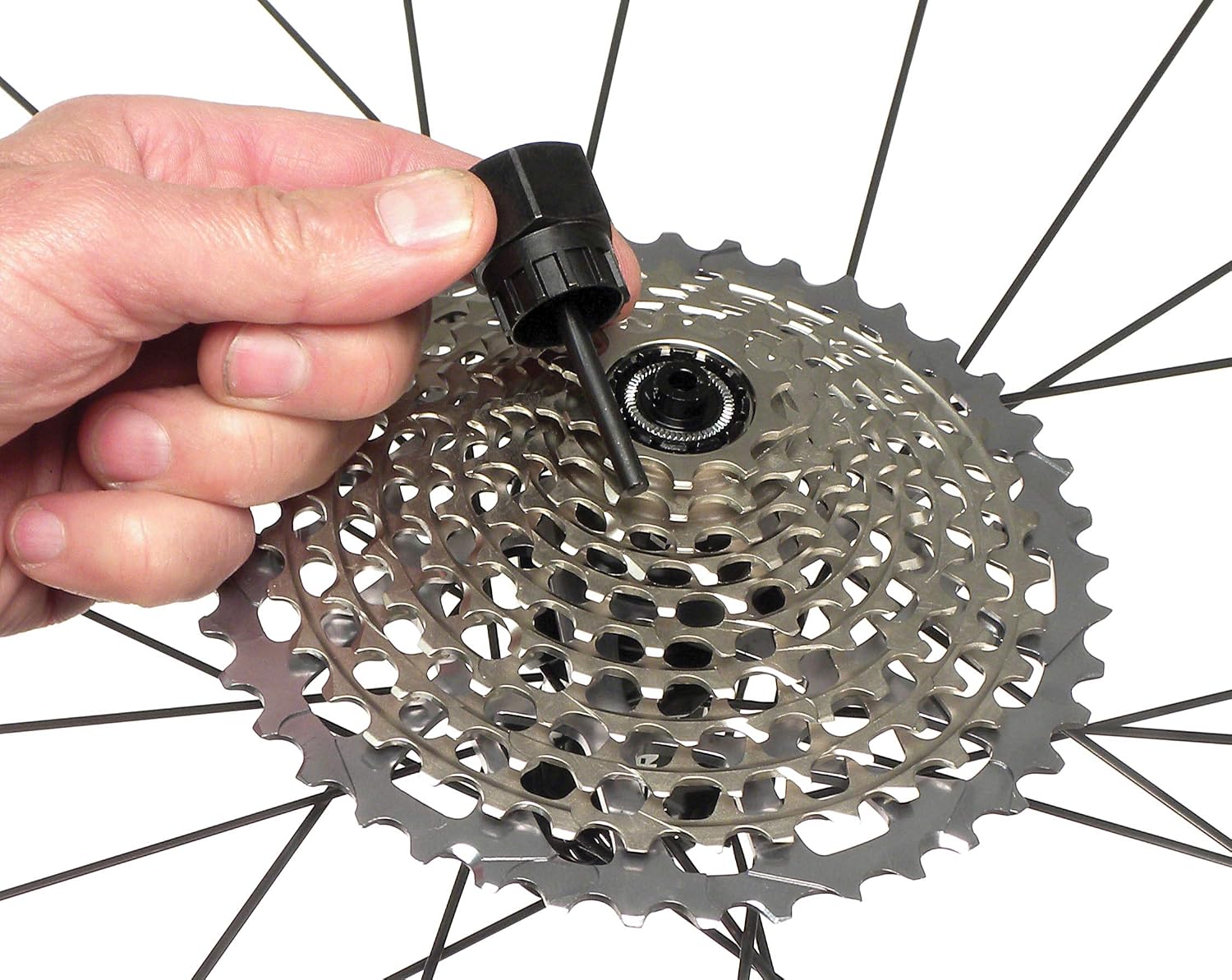
Your cassette is the cluster of sprockets (the gears) bolted onto the rear wheel’s hub. Swapping it out is routine maintenance — you’ll do it when the teeth wear down, when you’re changing gear ranges, or when you’re upgrading a drivetrain. But here’s what surprises a lot of people the first time: the cassette doesn’t just unscrew. It’s locked in place by a threaded ring called a lockring, and getting that lockring off requires a specific tool that matches your particular hub and cassette system. Use the wrong tool, apply force in the wrong direction, or skip a holding tool entirely, and you can shred the soft aluminum splines (the ridges that transfer force) on your freehub body — the ratcheting mechanism inside your rear wheel. Freehub bodies run $50 to $200 depending on the hub brand. This article will walk you through exactly which tools you need for the two most common systems on performance bikes right now — Shimano’s HG interface and SRAM’s XD/XDR interface — so you can do this job confidently and without collateral damage.
Why the Tool-to-System Match Actually Matters
This isn’t one of those cases where “close enough” gets you through. The lockring interfaces for Shimano HG and SRAM XD are physically different standards, and crossing them is how freehubs and tools get damaged.
Shimano HG (Hyperglide) has been the dominant cassette standard since the mid-1990s. An HG cassette slides onto a freehub with eight external splines, and the lockring threads into the center of the freehub using a notched tool interface. The removal tool — universally called a cassette lockring tool — has external splines that engage those notches. The most referenced spec here, per the Park Tool Company’s cassette removal and installation technical guide, is that the lockring uses a standard right-hand thread: you turn it counter-clockwise to loosen. The catch is that when you’re unthreading the lockring, the cassette wants to spin with it. That’s where a chain whip comes in: a tool with a short length of chain that wraps around one of the larger sprockets to hold the cassette stationary while you break the lockring loose.
SRAM XD and XDR are a completely different architecture. Instead of a splined freehub body with a separate lockring, the XD driver has external threads machined directly onto the freehub body, and the cassette threads directly onto those threads as one piece. There’s no separate lockring. To remove an XD cassette, you need an XD cassette tool — a splined fitting that engages a 12-point interface on the cassette’s smallest cog — and the cassette itself threads off counter-clockwise. No chain whip required, because the interface is direct; the tool holds both the driving and the locking function simultaneously.
The practical consequence: your HG lockring tool will not work on XD, and vice versa. They look vaguely similar in a parts bin, which is how mistakes happen.
The Core Tools by System
Shimano HG: Two Tools, Not One
For any Shimano HG cassette removal, you need both of these:
1. Cassette lockring tool — The Park Tool FR-5.2 is the most cited reference-grade option across aggregated workshop reviews, including Park Tool’s own documentation. It fits Shimano HG, Campagnolo, and most Shimano-compatible cassettes (including SunRace and others that use the same notch pattern). The FR-5.2 version includes a center pin that keeps the tool seated in the lockring during removal — a meaningful improvement over older designs that could pop out under torque. BikeRadar’s drivetrain tool coverage consistently notes this as the workshop standard. For a budget-conscious option, the Shimano TL-LR15 is the OEM tool and widely available; it works correctly but lacks the center-pin retention feature.
2. Chain whip — You need this to hold the cassette stationary. Without it, the cassette rotates with the lockring and you accomplish nothing — or worse, you round off the lockring notches. The Park Tool SR-18.3 or the Pedro’s Pro Chain Whip are both well-regarded in professional workshop contexts. The key spec to check: chain pitch compatibility. If you’re working on a 12-speed drivetrain with narrower chain, confirm the chain whip’s chain section is 12-speed compatible; some older whips use wider 9/10-speed chain that won’t seat properly on narrow-pitch sprockets.
One exception worth knowing: Shimano’s microspline freehub (used on some 12-speed Shimano cassettes, including the CS-M9100 XTR series) uses a different lockring tool — the Shimano TL-LR15-S, which has a different spline count. Per Shimano’s SI technical documents on HG freehub spline interface specifications, the microspline driver has 12 splines versus the traditional HG’s single notched-ring interface. Always confirm your freehub type before ordering tools.
SRAM XD and XDR: One Tool Does It
SRAM’s XD system is simpler from a tooling standpoint. The SRAM XD cassette removal tool (SRAM part number XX1 or aftermarket equivalents like the Enduro XD tool) engages the 12-point pattern on the small cog of the cassette. You attach a torque wrench or breaker bar, turn counter-clockwise, and the cassette comes off. No chain whip needed.
XDR (the road and gravel variant of XD, used with SRAM’s 12-speed road cassettes on AXS groupsets) uses the same tool interface. Per SRAM’s XD and XDR driver technical documentation, the cassette threading and tool engagement points are identical between XD and XDR — the only difference is the driver body’s freehub compatibility with road versus mountain hubs.
Owners across long-run reviews note that the XD tool interface can become difficult to seat cleanly if the cassette has been torqued very tightly (which is common after extended riding under load). Applying penetrating lubricant to the thread interface and allowing soak time before removal is a commonly recommended practice in BikeRadar’s drivetrain coverage.
By the Numbers
| System | Tool Required | Chain Whip? | Approx. Tool Cost |
|---|---|---|---|
| Shimano HG (8–11sp) | Cassette lockring tool (e.g., Park FR-5.2) | Yes | $15–$35 |
| Shimano HG (12sp microspline) | TL-LR15-S (microspline-specific) | Yes | $20–$40 |
| SRAM XD / XDR (12sp) | XD cassette tool | No | $15–$30 |
| Campagnolo (N3W, 12sp) | Campagnolo UT-BB130 or compatible | Yes | $25–$50 |
Note: Campagnolo’s N3W freehub standard, used on Bora and Shamal wheelsets paired with Super Record 12-speed, requires its own tool — it is not cross-compatible with Shimano HG tools despite visual similarity.
Torque, Technique, and Avoiding the Most Common Mistake
Sheldon Brown’s freewheels and cassettes reference article — still one of the most-cited practical references in workshop circles — makes a point that gets glossed over: the lockring torque on reinstallation matters as much as the removal technique. Shimano’s published specification for HG lockring installation torque is 40 Nm. Under-torquing leads to cassette movement and accelerated wear; over-torquing on an aluminum freehub body can strip threads.
That spec is the reason the Wera 7274 or the Park Tool TW-6.2 beam torque wrench show up repeatedly in serious workshop setups. For a one-off job, a calibrated click wrench will do. But if you’re maintaining multiple bikes — or if you’re a coach or small-shop mechanic turning over cassette swaps regularly — a quality torque wrench isn’t optional, it’s the control variable that protects $200+ freehub bodies.
The actual most common mistake isn’t using the wrong tool — it’s skipping the chain whip and trying to brace the cassette by hand or against the floor. The cassette has enough rotational freedom to spin freely under any meaningful torque input, and improvised bracing concentrates force on sprocket teeth in ways that can bend them. The chain whip is a $20–$35 tool that protects a $150–$400 cassette. The math favors owning it.
For SRAM XD, the equivalent mistake is applying removal force without confirming the tool is fully seated in the 12-point interface. A partially seated tool will cam out and round the engagement points. Seat it fully, apply steady counter-clockwise force, and if it’s truly stuck, soak the thread interface rather than increasing torque.
If X, Then Y: Your Decision Framework
If you’re running Shimano HG cassettes (8- through 11-speed, or older 12-speed setups): The Park Tool FR-5.2 plus a chain whip is the standard kit. Budget around $50–$60 for both. This covers the vast majority of Shimano-compatible cassettes on the market.
If you’re running Shimano 12-speed with a microspline freehub (XTR, XT, or Dura-Ace 12-speed road): You need the microspline-specific tool (TL-LR15-S). Confirm your freehub type first — look for the 12-spline driver body rather than the single-notch HG interface.
If you’re running SRAM XD or XDR (any Eagle, AXS, or Force/Rival 12-speed road cassette): One XD cassette tool handles removal and installation. No chain whip required. This is the simpler tooling situation of the two systems.
If you’re building or maintaining multiple bikes across both standards: Buy both tool sets. The combined cost — under $100 for quality versions — is trivial against the cost of a single damaged freehub body. Mechanics and coaches running mixed fleets consistently report that keeping dedicated tool sets for each standard is faster and safer than confirming compatibility at each job.
If you’re working on Campagnolo 12-speed (N3W): Neither the HG nor the XD tool applies. Source the Campagnolo-specific tool and confirm compatibility with your specific wheelset.
The freehub body on a Chris King, Hope, or DT Swiss hub isn’t a consumable — it’s a precision component that should outlast multiple cassette cycles. The tool set that protects it costs less than 10% of what the hub costs to replace. Match the tool to the standard, use a torque wrench on reinstallation, and the job is genuinely straightforward.