A bicycle chain doesn’t snap dramatically — it slowly stretches. Every pedal stroke pushes the pins and rollers apart by a microscopic amount, and over thousands of kilometers those tiny gaps add up. We call this “chain wear” or “chain stretch” (technically it’s pin and bushing wear, not the metal itself elongating, but the effect is the same: the chain grows longer between links). When a worn chain runs against your cassette — the cluster of gears on the rear wheel — it accelerates wear on those cogs. Replace a chain at the right time and a $30–$50 chain protects a $150–$600 cassette. Miss the window and you’re replacing both. A chain checker is the simple gauge tool that tells you where you are in that window. The problem is that not all chain checkers measure the same thing, and that difference can cost you a cassette — or cause a chain to be swapped out unnecessarily. This article breaks down exactly why that is, which tool design is right for your drivetrain, and how to read the numbers correctly.
| EDITOR'S PICK[SRAM Chain Wear Check Tool](https://www.amazon.com/dp/B09MXKZ7D6?tag=greenflower20-20) | Mid-tier[Chain Checker Plus II](https://www.amazon.com/dp/B075VR82NN?tag=greenflower20-20) | Budget pick[Park Tool CC-3.2 Bicycle Chain](https://www.amazon.com/dp/B000BR3LHQ?tag=greenflower20-20)… | |
|---|---|---|---|
| Size support | — | — | 5-12 Speed |
| Color | — | Black | Silver |
| Brand | SRAM | Chain | Park Tool |
| Price | $40.00 | $18.75 | $12.95 |
| See on Amazon → | See on Amazon → | See on Amazon → |
The Moment That Exposes the Problem: Two Checkers, Two Different Answers
Here’s the scenario that sharpens this whole debate: a mechanic runs a two-point checker on a chain and gets a “replace” reading. They pull out a three-point checker and run the same check — the chain still shows life remaining. Same chain, same day, two different results. This isn’t a fluke. BikeRadar’s chain wear checker buyer’s guide coverage documents this divergence consistently as a function of measurement design, not tool defect.
The difference comes down to how many contact points each tool uses.
Two-point checkers measure wear by dropping pins into two specific link positions a fixed distance apart. The gauge is designed around the nominal 12-inch (304.8 mm) span of a new chain over a set number of links. As the chain wears, the pins seat deeper — or the tool rocks — and a go/no-go indicator tells you whether you’ve hit 0.5% or 0.75% wear. Simple, fast, and widely used.
Three-point checkers add a third contact point — typically a roller or pin that tensions the chain upward between the measurement span. That third point eliminates slack in the lower run of the chain during measurement. Without it, a two-point checker can read slack as wear, reporting false positives on chains that still have real service life left. The Sheldon Brown technical reference on chain measurement (sheldonbrown.com, “Chain Measurement and Replacement”) explicitly notes that measurement accuracy depends on eliminating chain sag and lateral movement during the check.
This is not a small difference in a real workshop context. If you’re running a high-end SRAM or Shimano groupset, a false positive on chain wear doesn’t just cost you a $50 chain — it means you’re second-guessing a data point you’re relying on to protect significantly more expensive cassette teeth downstream.
The Wear Threshold Question: 0.5% vs. 0.75% and What They Actually Mean
Most chain checkers offer two readings: 0.5% wear and 0.75% wear. These are the percentage by which your chain has elongated beyond its nominal new length. Knowing which threshold to act on matters more than the checker brand.
By the Numbers
| Drivetrain Type | Replace At | Reasoning |
|---|---|---|
| 10–12 speed road (Shimano, SRAM, Campagnolo) | 0.5% | Narrow chains, tighter cassette tolerances |
| 11-speed general | 0.5–0.75% | Depends on cassette material; steel cogs more forgiving |
| SRAM T-Type / Flat-Top 12-speed | 0.5% or per SRAM tool reading | Unique chain geometry; standard gauges may not apply |
| 1x MTB with steel cassette | 0.75% | Wider range, more material on cogs |
| Entry-level 8–9 speed | 0.75% | Greater tolerances; cassette replacement cheaper |
The 0.5% threshold exists because narrow, high-speed chains on modern 11- and 12-speed drivetrains engage cassette teeth over a very small contact area. Once the chain pitch elongates to match a worn cassette, the chain starts hopping and skipping — and you’re replacing both components. Catching it at 0.5% gives you a meaningful window before that happens.
The 0.75% threshold is a “last call” reading. At this point the chain has almost certainly begun accelerating cassette wear. On an entry-level drivetrain with a steel cassette, this may still be an acceptable service interval. On a premium cassette — the kind of component investment where Park Tool’s CC-4.2 user documentation specifically positions the tool for protecting high-value drivetrains — 0.75% is too late.
BikeRadar’s chain checker buyer’s guide surfaces a consistent reviewer pattern: riders who run to 0.75% on a premium cassette then install a new chain and immediately feel chain skip, because the cassette teeth have worn to match the elongated chain pitch and a new chain won’t seat correctly. The math on that outcome is straightforward: one missed 0.5% reading costs more than the price difference between any two chain checkers in this comparison.
Tool-by-Tool Breakdown: Where Each Design Fits
Park Tool CC-3.2 — The Reliable Baseline
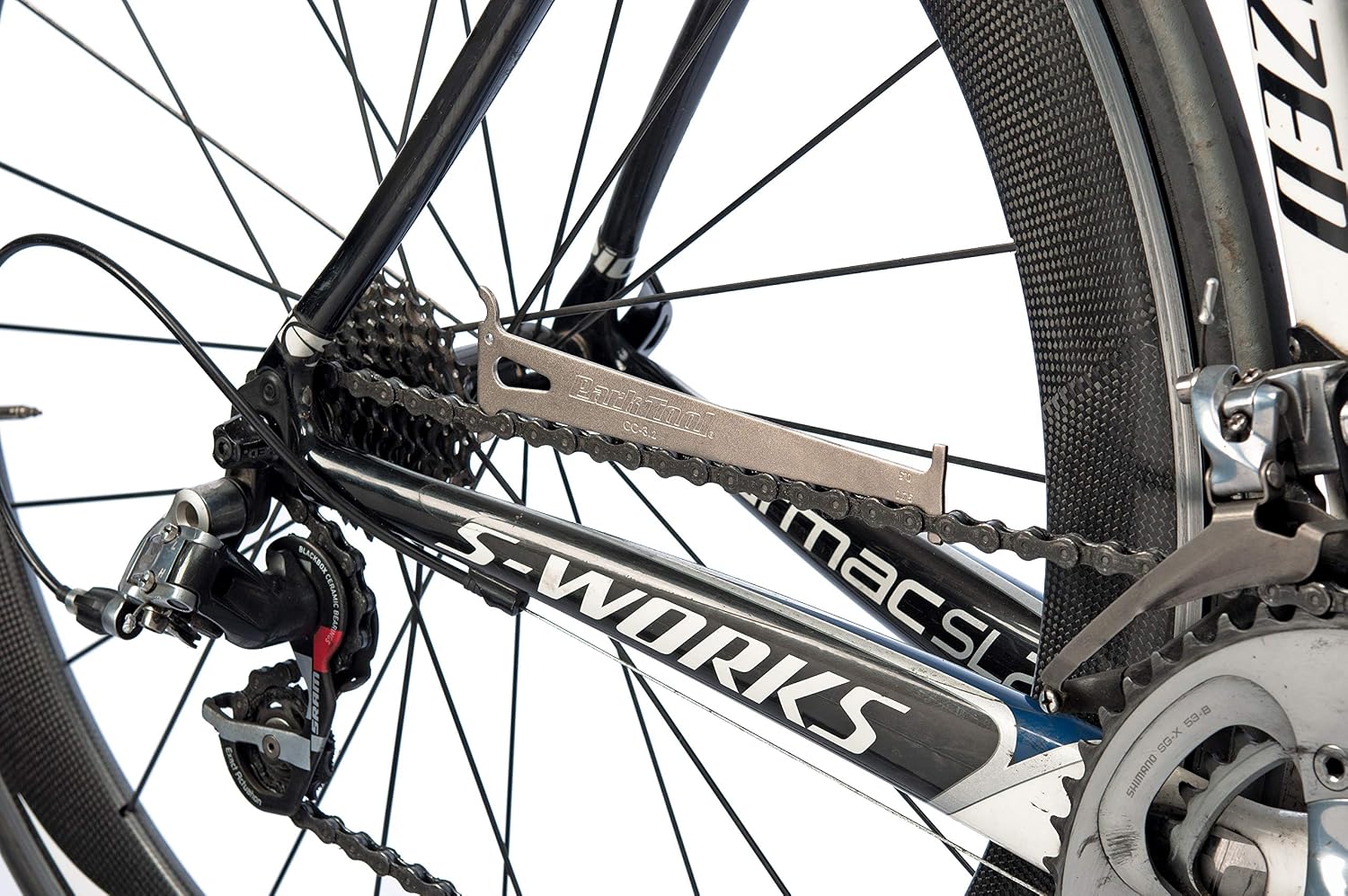
The CC-3.2 is the most widely used chain checker in home workshops, and for most drivetrains up through standard 11-speed it delivers reliable go/no-go readings. It’s a two-point design with a machined aluminum body, 0.5% and 0.75% indicators, and enough physical feedback to be genuinely useful. Park Tool’s product documentation for the CC-3.2 positions it as the standard service-interval tool for conventional Shimano and SRAM drivetrains in 10- through 12-speed configurations outside the T-Type ecosystem.
Where it falls short: on modern narrow-chain drivetrains — particularly SRAM T-Type flat-top chains — the two-point design isn’t on SRAM’s approved tool list for that specific system. For a standard Shimano or SRAM drivetrain on a cassette under $150, the CC-3.2 gives you reliable service-interval data.
Park
$12.95
In stock on Amazon
Check price on AmazonPark Tool CC-4.2 — The Two-Point Upgrade
The CC-4.2 is the step-up model: a longer gauge body that improves accuracy by spreading the two measurement points further apart, which reduces angular measurement error. Park Tool’s own CC-4.2 product documentation specifically calls out its improved accuracy on narrow-chain drivetrains, and the tool is positioned in Park Tool’s lineup for riders maintaining multiple high-end bikes or protecting cassettes above $200.
Reviewer coverage in BikeRadar’s chain checker buyer’s guide notes the CC-4.2 consistently as the two-point tool worth upgrading to if cassette value justifies tighter measurement confidence. It is confirmed on SRAM’s published approved tool list for T-Type Eagle AXS chains — buyers should verify against SRAM’s current T-Type documentation directly, as approved lists are updated with each major drivetrain revision, but that placement has been consistent across independent sources at the time of this article’s research.
Chain
$18.75
In stock on Amazon
Check price on AmazonPedro’s Chain Checker Plus II — The Three-Point Case
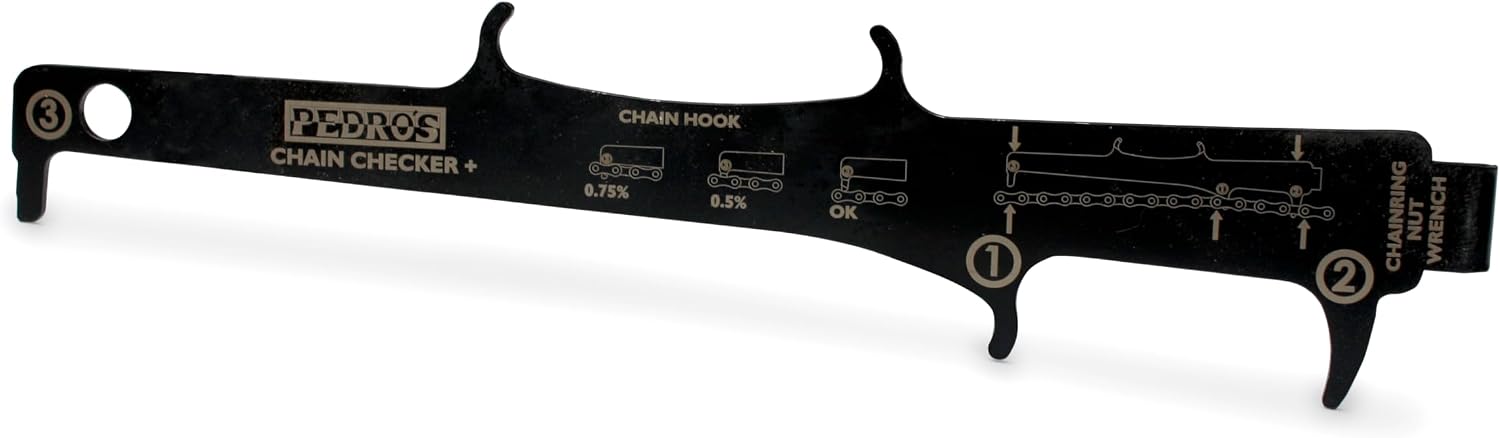
Pedro’s uses a three-point measurement design — the third contact roller tensions the chain segment upward during measurement, which eliminates the sag-based false positives described earlier. The net effect that reviewers consistently describe in BikeRadar’s chain checker coverage: fewer false positives, meaning you’re replacing chains based on actual wear data rather than measurement artifact.
Pedro’s Chain Checker Plus II has been confirmed by independent reviewers as appearing on SRAM’s approved tool list for T-Type Eagle AXS chains. As with the CC-4.2, prospective buyers should verify current compatibility directly against SRAM’s published T-Type documentation before purchasing — approved tool lists evolve — but that confirmed placement is consistent across multiple sources at the time of this article’s research. SRAM’s T-Type chain uses a unique flat-top link geometry that changes how a standard go/no-go pin seats, which is precisely why SRAM publishes an approved tool list rather than leaving measurement open-ended.
SRAM
$40.00
In stock on Amazon
Check price on AmazonA Note on SRAM’s Own Chain Checker and Technique
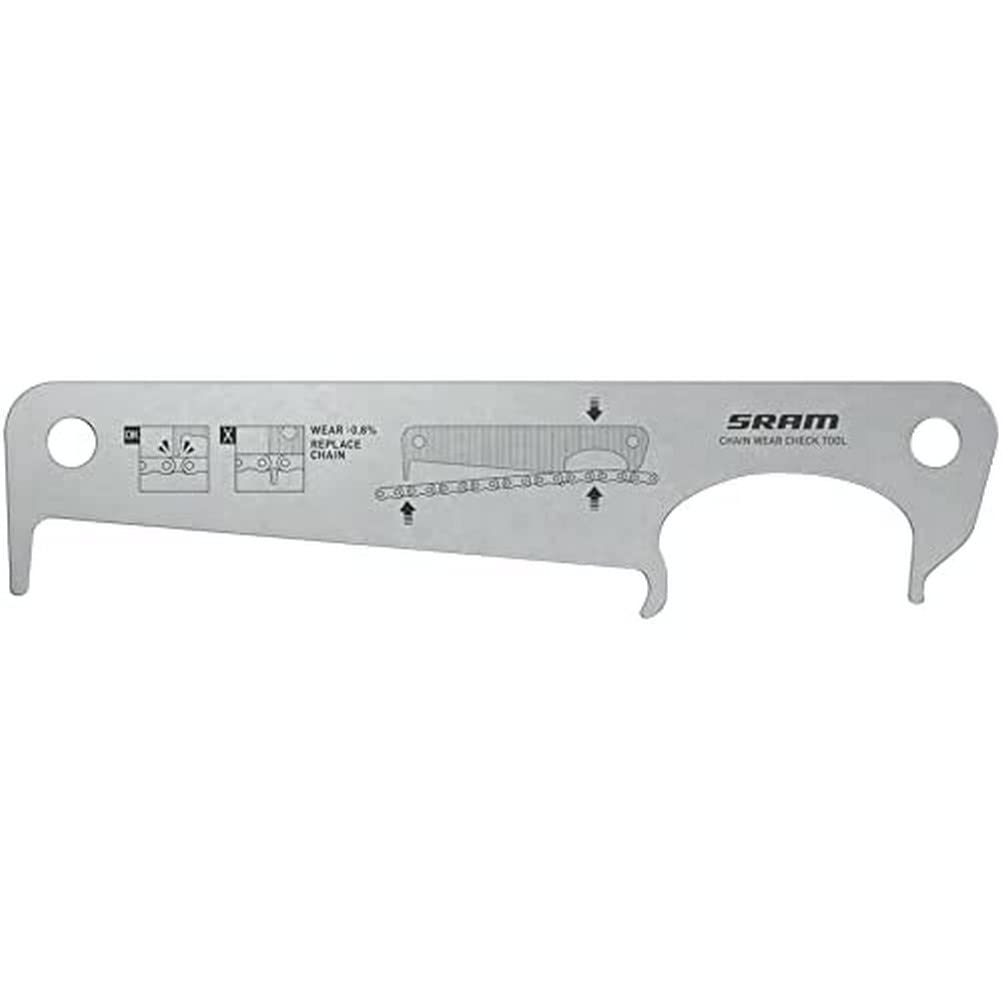
SRAM publishes technique guidance with their chain checker that deserves direct attention: you must tension the chain upward (toward the right side of the bike) between the pins during measurement. SRAM’s published tool documentation makes this explicit. Multiple reviewers and mechanics have documented seeing incorrect usage — chain left slack, checker dropped in, reading taken — which produces consistently optimistic (false-negative) readings. The technique note isn’t a footnote; it’s load-bearing for accurate measurement.
Entry-Tier Two-Point Gauges
Generic two-point checkers from brands like BikeHand follow the same basic geometry as the Park CC-3.2 and for 8- and 9-speed drivetrains with mid-range steel cassettes, they do the job. Owners on forums and in BikeRadar buyer’s guide commentary consistently report “works like it should” for these simpler applications.
Where they fall short: on modern narrow-chain drivetrains, especially SRAM T-Type, the lack of SRAM tool-list validation means you’re measuring without confirmed accuracy. For a $30 cassette, that’s a reasonable risk. For a $400–$600 cassette, it isn’t.
Frequently Asked Questions
Can I use a standard two-point chain checker on a SRAM flat-top AXS chain? Standard two-point checkers that are not on SRAM’s approved tool list for T-Type flat-top chains may produce inaccurate readings. The flat-top link geometry changes how the checker pin engages. For T-Type drivetrains, use a tool confirmed on SRAM’s current approved list — verify directly against SRAM’s published T-Type documentation before purchasing.
What is the difference between 0.5% and 0.75% wear readings and when should I actually replace? On modern 11- and 12-speed drivetrains with premium cassettes, replace at 0.5%. The narrower chain and tighter tooth geometry mean cassette wear accelerates quickly once the chain passes this threshold. The 0.75% reading is a hard limit — at that point, cassette wear has almost certainly already begun on a high-end drivetrain. On wider-tolerance 8–9 speed drivetrains with steel cassettes, 0.75% is a reasonable service threshold.
Why did my chain checker say replace but my new chain felt the same as the old one? If the new chain feels identical to the old one — same shifting feel, no improvement — the cassette teeth have likely worn to match the elongated chain pitch. A new chain on worn cogs won’t seat correctly and will skip under load. The solution is replacing the cassette alongside the chain. This is exactly the outcome that catching wear at 0.5% prevents.
How do three-point chain checkers reduce false positives? The third contact point tensions the chain segment upward between the two measurement pins, eliminating sag in the chain during measurement. Without this tension, a two-point checker can interpret slack in the lower chain run as elongation — reading wear that isn’t there. Three-point designs measure the actual pin-to-pin distance without that artifact, as the Sheldon Brown chain measurement reference explains in its discussion of measurement technique variables.
Does a more expensive chain checker actually measure more accurately? For standard drivetrains, consistency across price tiers is reasonable — the basic geometry works. The accuracy advantage of premium tools shows up in two specific contexts: narrow-chain drivetrains where small measurement errors matter more, and T-Type flat-top chains where SRAM’s approved tool list matters for validated accuracy. If you’re maintaining a $600 cassette or a SRAM T-Type system, the price difference between a generic and a validated checker is a rounding error against the replacement cost.
The Decision Rule
If you’re running standard 10- or 11-speed Shimano or SRAM on a cassette under $150, the Park Tool CC-3.2 or a comparable two-point gauge — see the budget-pick recommendation above — gives you reliable service-interval data. If you’re protecting a cassette above $200, running SRAM T-Type AXS, or maintaining multiple high-end bikes where false positives waste time and money, move to a three-point design or a tool confirmed on SRAM’s current approved list, and check at 0.5%. The checker doesn’t save your drivetrain; catching the number at the right threshold and acting on it does. The tool just has to give you a number you can trust.