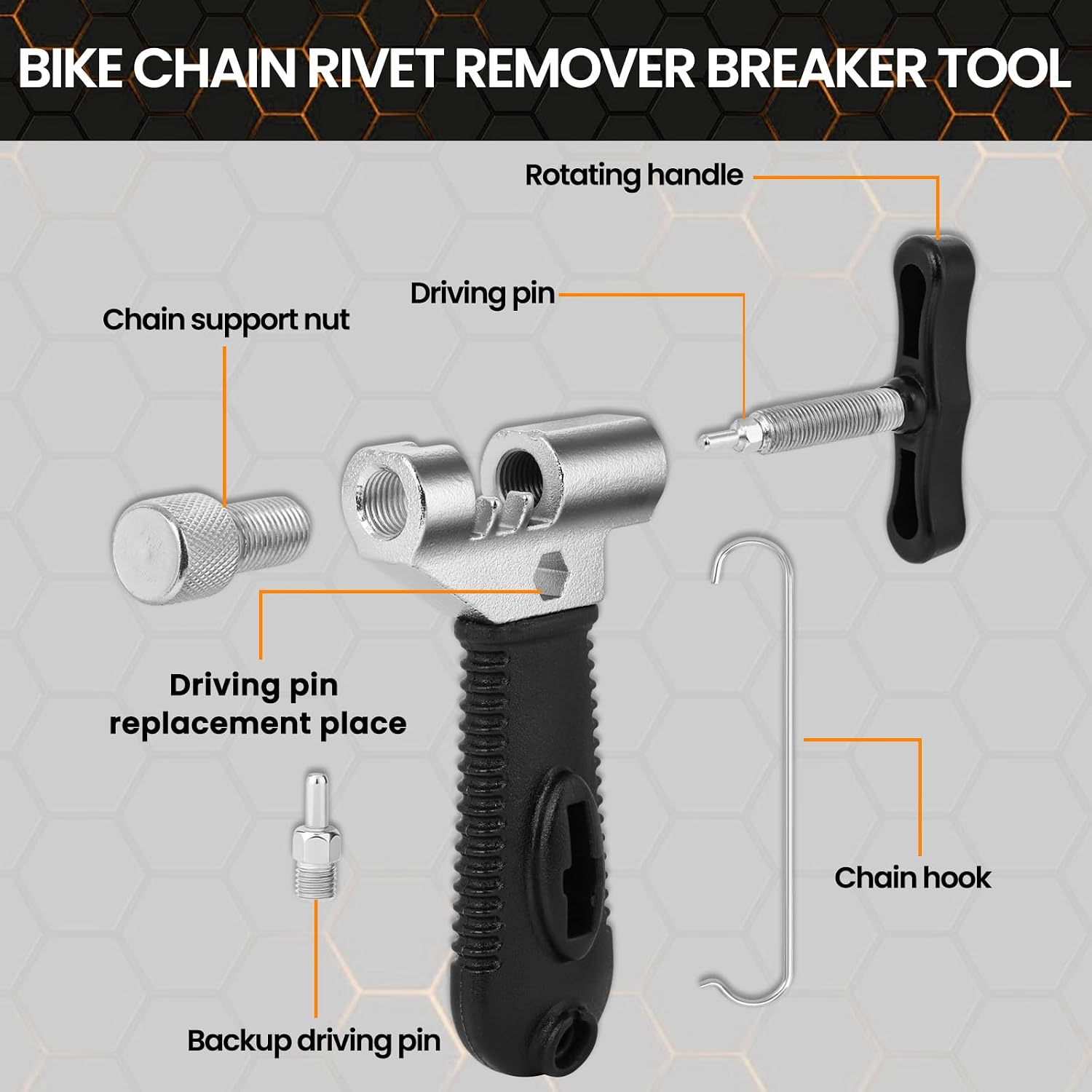
Your bicycle’s chain is the single most replaced component in a drivetrain — the mechanical bridge between your legs and your rear wheel. Over time, chains stretch (the pins and rollers wear, causing the spacing between links to grow slightly), which accelerates wear on your cassette and chainrings. Replacing a chain before it chews through those more expensive parts is basic, high-return maintenance. To do it, you need two tools: a chain breaker (sometimes called a chain tool), which pushes the steel pin out of a link so you can separate and size the chain, and master link pliers, which open and close the quick-connect links — called master links or quick links — that most modern chains use instead of a traditional pin. This guide maps out what to buy at each level of commitment, explains what the specs actually mean, and ends with a clear decision rule so you leave with a shortlist, not a headache.
Why Your Tool Choice Actually Matters Here
Chain tools look deceptively simple — a threaded handle, a drive tip, a chain cradle. But a misaligned drive tip or a cradle that doesn’t match your chain’s speed rating can shear a pin, damage a side plate, or leave a stiff link that skips under load exactly when you don’t want it to. The stakes are proportional to your drivetrain investment. On a 12-speed SRAM Red AXS or Shimano Dura-Ace Di2 chain — components where the chain alone runs $50–$80 — a $12 no-name chain breaker with sloppy tolerances is a genuinely poor tradeoff.
Speed compatibility is the first decision gate. Chains are sized by the number of sprockets on your cassette (8-, 9-, 10-, 11-, or 12-speed), and inner width narrows as speeds increase. A 12-speed chain is measurably narrower than a 10-speed chain, and a quality chain breaker needs a cradle and drive pin that can handle that geometry without canting the pin sideways. Park Tool’s technical documentation explicitly separates its CT-3.3 and CT-4.3 models by speed range for this reason.
Master link pliers matter for a related but different reason: modern quick links — SRAM’s PowerLock, Shimano’s Quick-Link, KMC’s Missing Link — are designed to snap closed under tension and require specific lateral pressure to open. Trying to open them with needle-nose pliers or tire levers risks deforming the link or, worse, creating an invisible fatigue point. The tool costs $10–$25 and removes both the fumbling and the risk.
By the numbers:
- A quality chain runs $30–$80 depending on speed and brand
- Cassette replacement cost: $60–$400 (budget aluminum to high-end titanium/ceramic)
- A worn chain left unchecked typically accelerates cassette replacement by 40–60%, per Park Tool’s chain wear documentation
- A mid-range chain tool + master link pliers combined: $40–$120 — paid back in one saved cassette
Chain Breakers: Matching the Tool to Your Drivetrain
The Budget-to-Mid Tier ($15–$45): Capable With Caveats
Tools in this range from brands like Birzman, Lezyne, and Pedro’s handle 8- through 11-speed chains adequately. The Pedro’s Chain Pig II has earned consistent mention in BikeRadar’s chain tool buyer’s coverage for its solid casting and non-slip chain cradle. Lezyne’s Steel Chain Drive — reviewed favorably across aggregated workshop tool roundups — is a common recommendation for mechanics who want something more robust than a multi-tool chain breaker without spending Park Tool money.
The caveat: cheaper chain tools often have stamped (rather than machined) drive pins. Owners report more frequent tip wear and occasional pin alignment issues, especially with tight 12-speed chains. If you’re working on one bike with an 8- or 9-speed drivetrain, a $20 tool is genuinely fine. If you’re touching 12-speed chains regularly — or if you’re maintaining SRAM Eagle or Shimano 12-speed MTB drivetrains — step up.
The Workshop Standard ($45–$120): Park Tool CT-3.3 and CT-4.3
Park Tool’s chain tool lineup is the reference point against which everything else is measured, and for reason: the CT-3.3 handles most 6- through 11-speed chains, while the CT-4.3 (introduced specifically for 12-speed narrower chains) features a revised drive tip geometry and cradle depth. Park Tool’s own technical documentation distinguishes the two by chain width compatibility, not marketing language — that specificity is meaningful.
Owners across long-run professional mechanic forums consistently report that Park Tool chain breakers hold their drive tip alignment through thousands of pin pushes, which matters if you’re running a small shop or maintaining a coach’s fleet. The handle leverage ratio is also notably better than budget tools, reducing the force required to start a pin push — a detail that matters less on a fresh chain and a lot more on an old, corroded one.
The CT-4.3 lists at roughly $65–$80 retail as of May 2026 and represents the clearest “buy it once” choice for anyone working on 11- or 12-speed drivetrains.
High-End Portability: Topeak and VAR
For mechanics who want bench-quality performance in a packable form, Topeak’s All-Speed chain tool handles 6- through 12-speed chains via an interchangeable pin system — a detail BikeRadar has highlighted in portable tool coverage. VAR (a Dutch professional workshop tool brand) produces machined chain tools used in UCI-licensed team service courses; these sit in the $90–$150 range and are genuinely over-specified for home use, but represent the top of what’s available if you’re equipping a proper bench.
Master Link Pliers: Small Tool, Outsized Impact
Why Not Just Use Pliers?
Sheldon Brown’s chain compatibility documentation notes that modern master links are engineered to hold under chain tension (some rated to 400+ kg breaking load) and require precise lateral compression to release. Standard pliers apply uneven force, risk scratching or deforming the link body, and make the process unnecessarily difficult. Purpose-built master link pliers use a curved jaw geometry that registers against the link correctly, applying inward compression that snaps the link open cleanly.
The Shortlist
Park Tool MLP-1.2 — The categorical default. Reversible jaw design opens and closes master links, comfortable grip, and it handles SRAM PowerLock, Shimano Quick-Link, KMC Missing Link, and Wippermann Connex links across 8- through 12-speed. Retail around $20–$25. Owners consistently report it as the first chain tool they wish they’d bought earlier. If you’re buying one pair, start here.
Shimano TL-CN10 — Shimano’s own master link pliers, recommended in Shimano’s SI technical documentation for use with their Quick-Link system. Narrower jaw design is purpose-built for Shimano’s geometry. At roughly $15–$20, it’s a logical pairing if your fleet is Shimano-only, but the Park Tool option is more versatile across mixed garages.
Var RP-71400 — A professional workshop pair with a longer handle for additional leverage, used in team mechanics’ toolkits. Overkill for a single bike but earns its place in a multi-bike workshop where you’re cycling through chain installations daily.
Pedro’s Chain Pliers — Consistently mentioned alongside the Park Tool option in BikeRadar and aggregated workshop tool reviews as a slightly more affordable alternative with solid build quality. Around $15 retail.
Compatibility Checkpoints Before You Buy
This is where practitioners get tripped up. Chain tools and master link pliers are largely cross-compatible across brands, but chains are not freely interchangeable across manufacturers at 11 and 12 speeds.
Key compatibility rules (current as of May 2026):
- SRAM 12-speed chains (Flattop architecture, used on AXS road and Eagle MTB) use SRAM’s PowerLock master link and are not compatible with Shimano 12-speed chains or links. Per SRAM’s technical documentation, Flattop chains require Flattop-compatible master links only.
- Shimano 12-speed Dura-Ace / Ultegra / XT chains use Shimano’s own Quick-Link (SM-CN910, SM-CN900 series). Shimano’s SI documentation specifies these are single-use links — do not reuse after opening.
- KMC chains are generally cross-compatible with Shimano and SRAM drivetrains at matching speeds, but KMC’s Missing Link is reusable (a genuine practical advantage). KMC’s own documentation confirms up to five reuses under normal riding conditions.
- Campagnolo 12-speed uses its own Ultra-Link and is chain-specific; third-party chains are not officially supported.
The practical implication: your chain breaker brand doesn’t dictate what chains you can use, but your master link pliers need to fit the link design your chain ships with. The Park Tool MLP-1.2 handles all of the above; the Shimano TL-CN10 is SRAM-compatible in practice but Shimano-optimized by design.
Torque note: Chain tools don’t operate to a torque spec in the traditional sense, but if you’re using a chain tool on carbon-fiber-adjacent components or working near a press-fit bottom bracket area, check that you’re not inadvertently applying frame stress. Chain pin installation is a bench operation — support the chain properly in the cradle rather than torquing against the frame.
The Decision Rule: If X, Then Y
Here’s how to map your situation to a shortlist:
If you maintain one bike with an 8–10 speed drivetrain and change chains once a season: A Pedro’s Chain Pig II or Lezyne Steel Chain Drive ($20–$35) paired with Pedro’s Chain Pliers or the Park Tool MLP-1.2 ($15–$25) is entirely sufficient. Total outlay under $60.
If you’re running an 11- or 12-speed road groupset (Shimano, SRAM, or Campagnolo) and change chains 2–3 times per year: The Park Tool CT-4.3 is the correct chain breaker; pair it with the Park Tool MLP-1.2. Budget $85–$110 combined. You’ll use both tools for years without questioning the decision.
If you’re a coach, small-shop mechanic, or maintain 4+ bikes across multiple speed standards: The Park Tool CT-4.3 for the bench, a Topeak All-Speed for mobile use, and at minimum two pairs of MLP-1.2 pliers (they walk away). Consider the VAR options if you want UCI-team-grade longevity. Budget $150–$250 for a complete chain service kit.
If you’re on SRAM AXS Flattop specifically: Confirm you’re using SRAM PowerLock links, not substituting Shimano or KMC links. Per SRAM’s technical documentation, Flattop geometry requires Flattop-specific links. The chain tool choice doesn’t change, but the compatibility checkpoint matters.
The tools themselves pay for themselves inside a single avoided cassette replacement. The math isn’t close — it’s just a matter of matching the tool tier to your actual usage volume.