Your bike’s drivetrain is held together at its center by two components most riders never think about until something goes wrong: the bottom bracket (the bearing assembly that lives inside the frame where the pedals connect) and the cranks (the arms that your pedals attach to, which transfer your leg power to the chain). Removing and replacing either one requires specific tools — and here’s where things get complicated. There isn’t one universal tool. There are at least half a dozen common standards, and using the wrong tool almost guarantees damaged threads, a ruined component, or both. This guide maps out exactly which crank puller and bottom bracket removal tool you need for the three most common drivetrain standards you’ll encounter: Square Taper (the older threaded spindle system still found on many entry and mid-range bikes), Hollowtech II (Shimano’s hollow-axle crank system used across Deore through Dura-Ace), and GXP (SRAM’s two-piece crank interface used from Rival up through Red). By the end, you’ll have a clear decision rule for each.
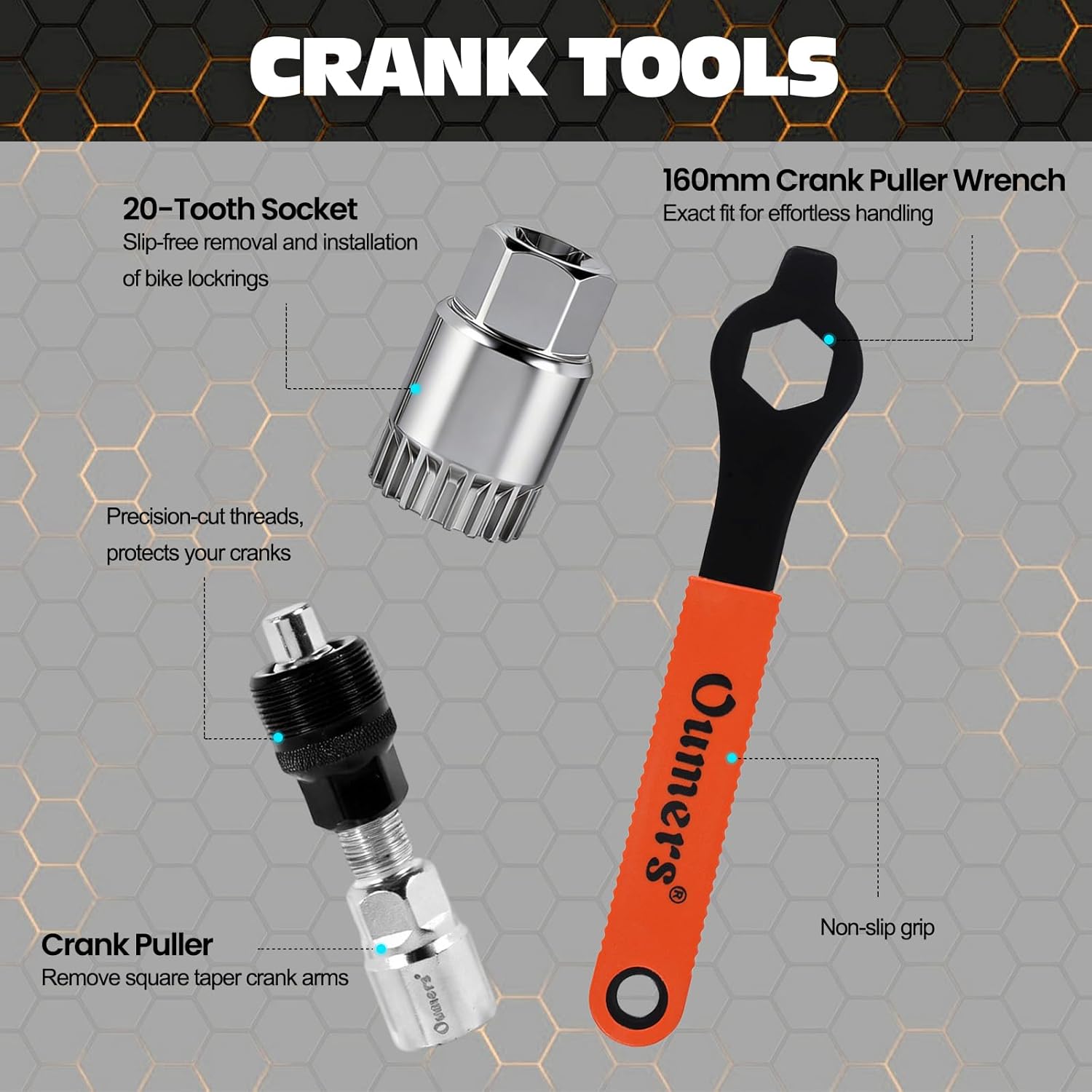
| EDITOR'S PICKBBT | Mid-tierBike Crank Puller & Bottom Brac… | Budget pickOumers Bike Crank Extractor/Arm… | |
|---|---|---|---|
| Tool type | Bottom bracket & pedal tool | Crank puller & BB removal tool | Crank extractor & BB remover |
| Compatibility | — | — | 16mm spanner/wrench |
| Handle length | — | Long handle | — |
| Kit includes | — | CT-B03+CT-T03 | — |
| Quantity in set | 1 | 2 | 1 |
| Color | Blue | — | Orange |
| Price | $29.95 | $26.63 | $12.98 |
| See on Amazon → | See on Amazon → | See on Amazon → |
Why Getting the Tool Combo Right Matters More Than You Think
The hidden cost of a wrong tool isn’t just the tool itself — it’s the component it destroys.
A threaded bottom bracket shell stripped by an undersized cup tool can mean a $300–$600 frame repair or replacement. A crank arm damaged by forcing a puller that doesn’t thread correctly is a $150–$400 part gone. Across aggregated workshop reviews and mechanic forums archived by BikeRadar’s workshop tools buyer’s guide, mismatched tooling is consistently cited as the number-one source of preventable drivetrain damage in home workshops.
The market context in 2026 makes this even more pointed: complete groupsets have climbed steeply, with Shimano 105 Di2 now retailing above $1,500 and SRAM Rival AXS cranksets pushing $400–$500 individually. Scratching a spider or over-torquing a pinch bolt because your puller slipped isn’t an abstract risk — it’s a real dollar figure.
By the numbers:
| Standard | Crank Interface | BB Shell Thread | Correct Puller | Correct BB Tool |
|---|---|---|---|---|
| Square Taper | Square spindle hole, 22mm | BSA 1.37” × 24 tpi | CCP-22 (Park Tool) | BBT-22 / BBT-32 |
| Shimano Hollowtech II | Integrated axle, pinch bolts | BSA or PF30/PF86 | TL-FC15 (Shimano) + lever | BBT-9 / 46mm spanner |
| SRAM GXP | Integrated axle, pinch bolts | BSA or press-fit | No dedicated puller needed | BBMD-2 or 16-notch BB tool |
Square Taper: The Workhorse Standard That Still Trips People Up
Square Taper is the oldest of the three and, paradoxically, the one most likely to cause problems because it looks simple. The spindle — the metal axle connecting the two crank arms — has a tapered square cross-section. The crank arm has a matching square hole. They’re pressed together under significant force. That’s the trap: they don’t bolt on; they’re driven on. Getting them off requires a crank puller that threads into the crank arm’s removal threads and then drives a center bolt against the spindle end.
The critical compatibility point: Square Taper crank arms use a 22mm thread on their extraction port. Park Tool’s BB Tool Selection Guide confirms the CCP-22 is the standard puller for this interface, though older European cranks — some Campagnolo and TA units — occasionally use a different thread pitch. Before buying, confirm your crank arm’s extraction thread diameter. A puller that doesn’t fully seat will cross-thread and ruin the arm.
For the bottom bracket itself, Square Taper units are almost always threaded — specifically BSA (British Standard, 1.37” × 24 tpi), which is right-hand threaded on the drive side and left-hand threaded on the non-drive side. That’s a detail Sheldon Brown’s Bottom Bracket Standards Reference emphasizes explicitly, and it’s the source of many rounded-off cups when mechanics forget to reverse direction on the drive side.
Recommended tool path for Square Taper:
- Crank puller: Park Tool CCP-22 or equivalent (look for a unit with a sliding T-handle; it gives enough leverage without requiring a cheater bar)
- BB cup tool: Park Tool BBT-22 (fits most BSA cups) or BBT-32 for Shimano-style notched cups
- Torque spec on reinstall: 35–50 Nm on the crank fixing bolt (confirm against your specific crankset’s documentation via si.shimano.com or the component manufacturer)
The total tool investment here runs roughly $30–$60 for quality versions of both tools — the lowest entry cost of the three standards, which makes this a good starting point for a home mechanic building a toolkit from scratch.
Shimano Hollowtech II: More Steps, Less Force — If You Have the Right Kit
Hollowtech II, introduced by Shimano in the early 2000s and now standard across their road and mountain groupsets from Deore to Dura-Ace, flips the engineering logic of Square Taper. Instead of a separate spindle that the cranks press onto, the right crank arm has the axle integrated into it. The axle passes through the bottom bracket bearings and the left arm clamps onto it with pinch bolts.
The crank removal process is actually gentler than Square Taper — no puller forces required — but it’s a two-step process with two different tools. Shimano’s own technical service manuals (available through si.shimano.com) specify:
- Remove the left-arm plastic preload cap using the TL-FC16 or the older TL-FC15 — a lightweight plastic tool that engages the cap’s notches. No torque required; this is finger-tight.
- Loosen the two or four pinch bolts on the left crank arm (typically 12–14 Nm — always confirm your groupset’s specific spec).
- Slide the left arm off, then pull the right arm and integrated axle out from the drive side.
The cap tool is where mechanics get caught out. Using a flat-blade screwdriver or a coin works once, maybe twice — but owners of high-cycle-count drivetrains consistently report damaged cap notches when improvising here. The TL-FC16 costs under $10 and eliminates that risk entirely.
Bottom bracket removal for Hollowtech II depends on your frame’s shell type:
- BSA threaded shell: You need a cup tool that engages the 16 notches on the Shimano SM-BB series cups. The Park Tool BBT-9 is the widely referenced match. The same thread-direction rule applies — non-drive side is right-hand, drive side is left-hand (reverse thread).
- Press-fit shells (PF30, PF86, BB90): These require a bearing press and drift set, not a cup tool. This is a separate and more expensive tool category — BikeRadar’s workshop tools guide estimates quality press-fit removal sets starting around $50–$120. If you’re working on press-fit frames regularly, this is not optional.
Total Hollowtech II tool investment (threaded shell): ~$40–$80 for cap tool, pinch bolt hex keys, and BBT-9 cup tool. Press-fit adds $50–$120+.
SRAM GXP and DUB: Know Which Generation You’re Working With
SRAM has run two distinct crank interface standards in recent years, and conflating them is the most common sourcing mistake practitioners make at the intermediate level.
GXP (Giga X Pipe) uses a two-piece crank where the right-side spindle is 24mm and the left side steps down to 22mm, allowing it to work with both 24mm and 22mm bottom bracket inner diameters. SRAM’s technical documents on sram.com describe GXP bottom brackets as threaded (BSA) or press-fit depending on frame spec.
DUB (Direct Engagement Universal Bottom Bracket) is SRAM’s newer standard, introduced around 2018, with a 28.99mm spindle. DUB and GXP cranks are not interchangeable — the spindle diameter difference makes them incompatible with each other’s bottom brackets.
Crank removal for both GXP and DUB follows the same process as Hollowtech II: loosen pinch bolts, remove the left arm, withdraw the right arm and spindle. No dedicated crank puller is needed — which simplifies the tool kit.
Bottom bracket removal is where tool specificity matters:
- GXP threaded cups use a 16-notch engagement pattern on some models, but others use a splined interface — Park Tool’s BBT-69 (for SRAM threaded cups) or BBMD-2 are the cited references in Park Tool’s BB Tool Selection Guide.
- DUB threaded BBs typically use the same 16-notch tool as GXP on the cup body, but always verify against the specific model number.
- SRAM press-fit variants again require a bearing press — same as Shimano press-fit shells.
The practical implication: if you’re maintaining bikes across both GXP and Hollowtech II drivetrains (a common scenario for shop mechanics and coaches), the 16-notch BB cup tool covers both. That’s one shared tool across two platforms — a meaningful efficiency in a multi-bike workshop context.
Building the Right Tool Combo: The “If X, Then Y” Decision Rules
Here’s the practitioner-level decision framework distilled from the above:
If you’re working on a Square Taper drivetrain — threaded frame, cotterless cranks, likely an older or budget build — buy the CCP-22 crank puller and a BBT-22 or BBT-32 cup tool. Total spend: $30–$60. This is your lowest-cost entry point and covers a wide range of vintage and entry-level bikes.
If you’re working on Shimano Hollowtech II in a threaded BSA shell — the most common scenario across Deore through Ultegra builds — buy the TL-FC16 cap tool and the Park Tool BBT-9. Add hex keys in the 4mm and 5mm sizes. Total spend: $40–$80. If you encounter a press-fit frame, add a bearing press/drift set before proceeding; don’t improvise.
If you’re working on SRAM GXP or DUB in a threaded shell — buy the Park Tool BBMD-2 or BBT-69 depending on your specific SRAM cup generation (confirm against sram.com technical documents). No crank puller needed — standard hex keys handle the pinch bolts. Total spend: $25–$55.
If you’re maintaining a multi-bike workshop with mixed standards — prioritize the 16-notch BB tool (it spans Shimano and SRAM threaded BBs), add the CCP-22 for any Square Taper outliers, and invest in a quality bearing press for press-fit frames. A three-tool core kit covering all three standards can be assembled for $100–$150, plus the press set if needed.
One final note on total cost of ownership: quality tools from Park Tool, Shimano, or Pedro’s at the $25–$80 tier will outlast dozens of component changes without wear. The budget alternatives — often encountered on marketplace sites — consistently draw owner reports of slipping engagement and rounded cup notches after a handful of uses. On a $400 crankset or a $600 groupset’s bottom bracket, that’s not a tradeoff worth making.