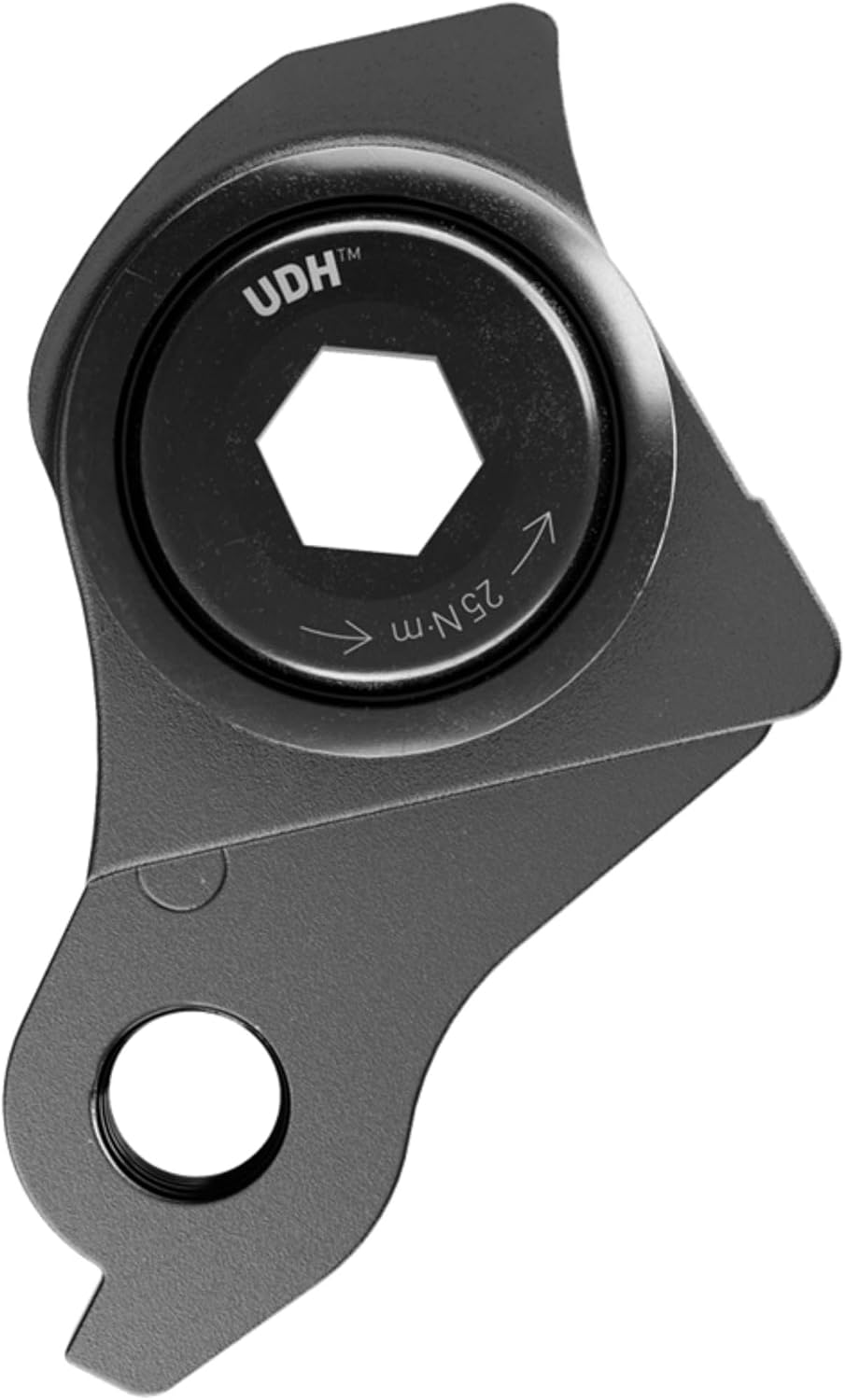
Your rear derailleur — the mechanism that moves the chain across your cassette gears — doesn’t bolt directly into your frame. Instead, it threads into a small sacrificial bracket called a derailleur hanger (sometimes called a mech hanger or dropout tab). That bracket is deliberately designed to be the weakest link in the chain: if your bike tips over or takes a hit on the drivetrain side, the hanger bends or snaps instead of cracking your frame. It’s a brilliant bit of engineering, and it works — right up until you need to replace the hanger and discover that there are hundreds of different shapes, hole patterns, and thread specs across bike brands, years, and models. No single hanger fits everything. If you’ve never had to buy one before, that realization can feel like a bureaucratic ambush. This guide will walk you through exactly how hanger identification works, when OEM parts are worth the premium, when aftermarket is the smarter call, and how to verify a new hanger is doing its job correctly.
Why Hangers Are Not Universal — and Why That Matters More Than You Think
The short answer, per Sheldon Brown’s rear derailleur hanger explainer, is that frame manufacturers never agreed on a standard mounting interface. Every brand optimized for their own dropout geometry, frame material, and derailleur compatibility — and the result is an ecosystem of roughly 500–700 distinct hanger shapes in active circulation. A hanger for a 2019 Giant Defy Advanced won’t fit a 2019 Trek Domane even though both are aluminum road bikes in roughly the same price bracket.
This isn’t just trivia. It has real purchasing consequences:
- Identification must happen before purchase. Buying “a hanger for a Trek” without a model number and year is a 50/50 gamble at best.
- The wrong hanger can look close enough to install but mis-align your derailleur by 2–3mm — enough to cause ghost shifting, chain skipping, and premature drivetrain wear without any obvious visual tell.
- Thread pitch matters. Most hangers use M10 x 1.0mm threads to accept the derailleur bolt, but some older platforms differ. Shimano’s SI document library for the Dura-Ace RD-R9200 confirms M10 x 1.0, but verify before you torque anything down.
The practical on-ramp for identification: Start with your bike’s model name, frame size, and year — all three. Trek hanger buyers consistently note in aggregated reviews that OEM part numbers are critical and that year-over-year frame revisions sometimes changed the hanger spec without changing the model name. If you have the original owner’s manual or the frame’s serial number, use it. If not, most major brands publish frame-specific part lookups on their websites, and hanger specialist retailers maintain cross-reference databases searchable by brand/model/year.
OEM vs. Aftermarket: Running the Real Tradeoff
This is the decision most riders hit after their first or second replacement, and it’s less clear-cut than “OEM = better.”
The case for OEM
OEM hangers are manufactured to the exact tolerances of the dropout they’re designed for. For carbon fiber frames — where dropout geometry is molded in and deviation tolerance is tighter — that precision matters. An off-spec hanger on a carbon dropout can introduce micro-flex that a derailleur alignment gauge won’t fully capture, because the gauge measures the hanger tip, not the full contact surface.
For bikes with integrated or semi-integrated dropout designs (common on high-end road frames and some gravel frames), OEM is also the safer bet because aftermarket tooling may not replicate the exact flange profile. Specialized and Trek riders in particular report that the brand-specific hanger geometry is tight enough that aftermarket substitutes occasionally require minor file work to seat cleanly.
OEM downside: availability. LBS backorder times of two to four weeks on OEM hangers are a documented frustration across rider communities, and that’s for popular models. Niche frame sizes or older models can stretch to months.
The case for aftermarket
For aluminum frames with conventional external dropouts — the majority of mid-range road, gravel, and mountain bikes — aftermarket hangers from reputable manufacturers are functionally equivalent to OEM in most measured ways. Aftermarket products from established hanger specialists are typically CNC-machined from 6061 or 7075 aluminum, and many carry published tensile strength specs comparable to OEM originals.
The cost delta is meaningful: OEM hangers from major brands typically run $20–$45. Quality aftermarket equivalents often land in the $8–$20 range. If you’re a shop mechanic maintaining 15–20 bikes, or a bikepacker who carries two spares, that math adds up quickly.
The decisive variable is material grade and sourcing. Aftermarket hangers from anonymous marketplace listings with no published alloy grade or machining spec are the ones that generate “snapped on the first ride” reviews. Stick to aftermarket brands that publish their material spec and have a documented compatibility cross-reference — those products have a track record worth evaluating.
By the numbers
| Scenario | OEM | Quality Aftermarket |
|---|---|---|
| Carbon frame, integrated dropout | ✅ Recommended | ⚠️ Verify fitment carefully |
| Aluminum frame, external dropout | ✅ Works | ✅ Works — cost advantage |
| Carrying trail spares | ⚠️ Expensive redundancy | ✅ Smart call |
| Older/discontinued frame | ⚠️ May be NLA | ✅ Often still in production |
The SRAM Universal Derailleur Hanger: What It Changes
SRAM introduced the Universal Derailleur Hanger (UDH) as an industry standardization attempt, and it’s worth understanding what it does and doesn’t solve. Per SRAM’s UDH specification documentation, the UDH is a defined interface standard that frame manufacturers license and build into their dropouts — meaning the hanger itself is interchangeable across all UDH-compatible frames regardless of brand.
Frames shipping with UDH as of mid-2026 include recent SRAM-partnered models from Specialized, Trek, Scott, Canyon, and others — predominantly in the gravel and mountain bike categories. Road adoption has been slower.
What UDH doesn’t eliminate: SRAM UDH reviewers specifically flag thread damage from improper derailleur attachment as a distinct failure mode separate from crash damage. The UDH hanger’s threads are M10 x 1.0mm, same as conventional hangers, and over-torquing or cross-threading the derailleur bolt on installation will strip the hanger regardless of how precisely it fits the dropout. Shimano’s published torque spec for derailleur mounting bolts is 8–10 Nm; SRAM’s documentation aligns closely. Use a torque wrench. Every time.
If your bike has UDH, your hanger sourcing just got significantly simpler — one part number covers the entire compatible fleet. But confirm your frame actually uses UDH (look for the flat, wing-shaped dropout profile) before assuming.
Field-Testing a Bent Hanger: The Water Test and When to Act
Before you spend money on a new hanger, confirm you actually need one. A hanger can look straight to the naked eye and still be bent enough to cause miserable shifting. The “Seth’s Bike Hacks water test” — referenced by multiple Specialized hanger buyers in aggregated review feedback — is a quick field check: fill a water bottle partway, hold it level against the derailleur cage with the bike on a flat surface, and watch where the water line falls relative to the cage angle. A straight hanger means the derailleur cage hangs parallel to the wheel; a bent hanger introduces a visible tilt. It’s not a precision instrument, but it catches obvious bends that eye-balling misses.
Can you ride with a slightly bent hanger? The honest answer is: briefly, and only to get home. Even a 1–2mm bend at the derailleur tip translates to measurable chain line deviation across the cassette. You’ll notice it first on limit adjustment — the derailleur will feel like it won’t quite dial in no matter how much you tweak the barrel adjuster. Riding with a known bent hanger on a longer route risks dropping the chain into the spokes under load, which can cause a very sudden, very bad day. Replace it before the next real ride.
Do you need a derailleur alignment gauge every time? Not necessarily for a routine swap where you’re putting the bike back to baseline after a crash. But if shifting still feels off after installing a new hanger — even a correct one — that’s when the Park Tool DAG-2.2 alignment gauge earns its keep. Per Park Tool’s DAG-2.2 use guide, even new hangers can arrive with minor manufacturing variance, and the gauge lets you correct that at the dropout rather than chasing phantom adjustments through the derailleur barrel and limit screws. For a shop mechanic or anyone maintaining multiple builds, the gauge pays for itself quickly in diagnostic time saved.
Why Your New Hanger Might Still Shift Poorly
This is one of the more common post-purchase frustrations, and it almost always comes down to one of four causes:
-
Wrong hanger, close fit. A hanger that’s 0.5mm off in the mounting hole position will shift poorly even if it installs without obvious force. Re-verify your model/year against the part number.
-
Hanger not seated flush. On frames with a locating pin or tab at the dropout, the hanger must fully engage that feature before the retaining bolt is torqued. A partially seated hanger introduces angular error that no amount of cable tension adjustment will fix.
-
Thread damage on installation. As noted in the UDH context above, cross-threading the derailleur bolt — even slightly — will misalign the derailleur even on a perfectly correct hanger. Inspect the threads, run a tap through if necessary, and start the derailleur bolt by hand before applying any torque.
-
Residual cable or housing issue. A bent hanger often causes cable-tension panic adjustments before diagnosis. Once the hanger is replaced, reset cable tension to baseline (barrel adjuster flush, cable anchored at factory spec) before dialing in indexing.
Frequently Asked Questions
How do I know which derailleur hanger fits my exact bike model and year? Start with your bike’s brand, model name, frame size, and build year — all four. Check the brand’s official parts lookup or contact their support line with the frame serial number. Hanger specialist cross-reference databases (searchable by brand/model/year) are also reliable. When in doubt, take the old hanger to an LBS for physical comparison before ordering.
What is the SRAM Universal Derailleur Hanger and which frames use it? The UDH is a licensed dropout standard developed by SRAM that makes the derailleur hanger interchangeable across all compatible frames. As of 2026, UDH is standard on many current-generation Specialized, Trek, Canyon, Scott, and other brand frames in gravel and MTB categories. Check for the distinctive flat, winged dropout profile to confirm.
Can I ride with a slightly bent hanger or does it need immediate replacement? Replace it before your next real ride. A bent hanger causes indexing drift and, under sustained load, can allow the derailleur to contact the spokes. Riding home on a gentle route is acceptable; continuing to ride knowingly is not.
Do I need an alignment gauge every time I swap a hanger? Not every time for a routine swap — but use one if shifting is still off after installation. Per Park Tool’s alignment gauge documentation, even correct new hangers can carry minor manufacturing variance that only gauging will reveal.
Why did my new hanger still shift poorly after installation? Most likely causes: wrong hanger with a close-fit, hanger not fully seated at the dropout locating feature, cross-threaded derailleur bolt, or residual cable tension from pre-diagnosis adjustments. Reset cable tension to baseline and re-verify the hanger part number before assuming a drivetrain problem.
The decision rule: If your frame is carbon or uses an integrated dropout, start with OEM — the fitment precision is worth the premium and the supply chain risk. If your frame is aluminum with a conventional external dropout, quality aftermarket is a legitimate choice that often ships faster and costs less; just verify the alloy spec and the cross-reference match before you click buy. If your bike shipped with SRAM UDH, your sourcing just got easy — one hanger, universal across the compatible ecosystem, and the main thing to protect is the thread on installation day.