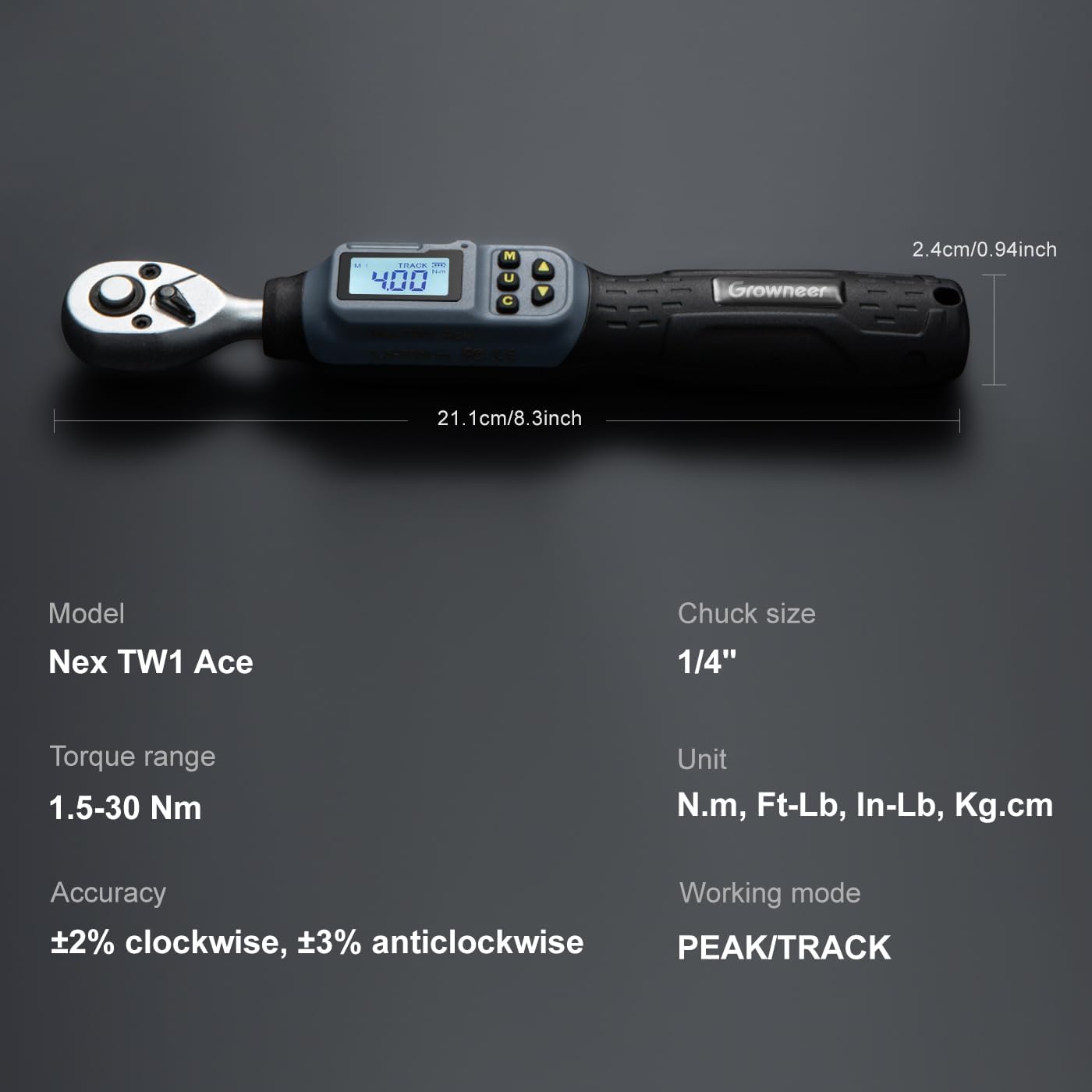
If you’ve ever stripped a carbon seatpost clamp or snapped a stem faceplate bolt, you already understand why torque matters. Torque is simply a measurement of rotational force — how hard you’re twisting a bolt. On a bike, nearly every bolt has a published torque specification in Newton-meters (Nm), the international unit for that twisting force. Tighten past the spec and you crack carbon, strip aluminum threads, or seize titanium. Tighten short of it and components shift, creak, or fail in traffic. The traditional solution is a click-type torque wrench, a tool that emits a mechanical click when you hit the target value. The newer alternative is the digital torque wrench, which displays live Nm readings on a screen and alerts you with a buzzer, LED flash, or both when you reach your preset value. The under-$60 bracket is crowded with digital options. This guide cuts through the noise to answer the one question that keeps appearing in owner reviews: do those buzzers and LEDs actually make these tools easier to use reliably, or are they marketing noise on a tool that matters too much to get wrong?
| EDITOR'S PICKGROWNEER Digital Torque Wrench | Mid-tierDigital Torque Wrench 0.44-8.8… | Budget pick1/4 Torque Wrench Digital(1.1-2… | |
|---|---|---|---|
| Torque range | 1.1–22.1 ft-lb | 0.44–8.8 ft-lb | 1.1–22.2 ft-lb |
| LED indicator | ✓ | — | ✓ |
| Includes sockets | ✓ | — | ✓ |
| Price | $74.39 | $64.99 | $60.99 |
| See on Amazon → | See on Amazon → | See on Amazon → |
The Real Problem These Wrenches Are Trying to Solve
Let’s be direct about the use case. The click-type torque wrench is a proven, well-understood tool. Park Tool’s TW-5.2 and TW-6.2 models, covered in Park Tool Company’s product documentation, are industry references precisely because the click mechanism is consistent and shop-proven. So why are cyclists — including experienced ones — reaching for digital alternatives?
The answer, surfaced repeatedly across owner reviews, comes down to low-Nm sensitivity. Carbon fiber components have reshaped bicycle fastener specs dramatically. Where a steel-framed bike might demand 10–15 Nm on a stem bolt, a carbon bar clamp often specifies 4–6 Nm, and some carbon fiber seatpost manufacturers specify as low as 2–4 Nm. At those values, the tactile and audible feedback from a click wrench becomes genuinely subtle — especially for someone working in a noisy garage, using a longer-handled wrench, or simply lacking the calibrated feel that shop mechanics build over years of repetition.
Sheldon Brown’s torque reference page flags this usability gap directly: the mechanical click is easiest to perceive at mid-to-high torque values, and the low end of a wrench’s range (typically the bottom 20% of its scale) is where accuracy degrades most on click-type tools. This is the opening digital wrenches are designed to exploit — a bright LED or a buzzer that fires regardless of ambient noise or the mechanic’s tactile sensitivity.
The pattern in owner reviews confirms this hypothesis. Self-described non-mechanically-confident cyclists appear disproportionately among digital torque wrench buyers, and a recurring complaint across click-wrench return reviews is that the user “never heard a click” at low Nm values. This is not a quality complaint about any specific click wrench — it’s a biomechanics and perception problem. Digital tools address it architecturally.
What the Specs Actually Say (And What They Don’t)
Before evaluating specific budget units, it’s worth establishing a calibration baseline. The ISO 6789 standard for torque wrenches defines two accuracy classes: Type I (indicating wrenches, which show live readings) and Type II (setting wrenches, which have a preset and alert at the target). Most digital wrenches under $60 are Type I devices — they show you a live Nm reading and alert at a user-set threshold.
By the numbers:
| Accuracy claim | What it means in practice at 5 Nm |
|---|---|
| ±4% (typical click wrench, low range) | ±0.2 Nm — acceptable for most steel/alloy bolts |
| ±2% (mid-range digital) | ±0.1 Nm — adequate for carbon at standard specs |
| ±1% (premium budget digital, claimed) | ±0.05 Nm — theoretically excellent; unverified by independent lab at this price tier |
The ±1% accuracy claim appearing on at least one sub-$60 unit is highlighted positively by owners, but no reviewer in the aggregated review set reports independent verification through a calibration lab. BikeRadar’s buyer’s guide notes that accuracy claims on unbranded or lesser-known digital wrenches should be treated as manufacturer assertions until confirmed by third-party testing. That’s not a reason to dismiss the tools — it’s a reason to apply them with appropriate scope (home workshop, personal bikes, non-safety-critical bolts) rather than treating them as shop-certified reference instruments.
Buzzer Loudness: The Variable Nobody Benchmarks
Here’s the tradeoff that actually matters for daily usability, and it varies more than spec sheets suggest.
Aggregated owner reviews reveal a bifurcation in buzzer performance that cuts across brands at this price point. On one end, owners of certain units report that the audible alert is — in their words — “loud enough that it’s impossible to mess up the job.” On the other end, at least one owner of a different unit explicitly states they “never did hear a noise” despite the product advertising audible alerts, and completed the job relying entirely on the LED indicator instead.
This is a significant usability gap. If you’re torquing a stem bolt with your head angled close to the bars, an LED that lights up in your peripheral vision may actually be more reliable feedback than a quiet buzzer you can miss. Conversely, if you’re working on a motor mount with your head turned away from the display — an increasingly common scenario as e-bike maintenance grows — a loud, unambiguous buzzer is worth more than any visual indicator.
The decision frame here: if your primary use is traditional bike bolts where you can keep eyes on the display, a clear LED is sufficient and a quiet buzzer is acceptable. If you’re working on e-bike motor mounts, battery enclosures, or controller brackets with your sightline off the tool, buzzer loudness becomes a hard requirement, not a nice-to-have.
Per VeloNews coverage of workshop practice for high-end builds, the e-bike application is worth calling out specifically. Motor mount bolts on mid-drive systems (common on cargo and commuter e-bikes) often specify 6–10 Nm — well within digital wrench range — but the working position can be awkward, making visual feedback unreliable. Battery box closures are increasingly specifying torque values to prevent vibration-induced loosening, and controller brackets on higher-end systems carry fastener specs in the 3–8 Nm range. Owners across multiple digital wrench reviews explicitly cite these applications, confirming that the e-bike audience is a real and growing segment for this tool category.
Where the Under-$60 Digital Wrench Fits (And Where It Doesn’t)
The honest positioning of these tools lives between “not precise enough” and “overkill money.” Let’s name the tradeoffs clearly.
Where budget digital wrenches earn their keep:
- Low-Nm carbon fiber bolts (2–5 Nm) where click feedback is hardest to perceive
- E-bike motor and battery fasteners where visual-only feedback is unreliable
- Home mechanics who work infrequently and haven’t built muscle memory for click perception
- Riders who want confirmation, not just sensation, that they hit the target
Where they fall short of professional-grade tools:
- Calibration longevity. Click wrenches from Park Tool or Wera are designed for periodic recalibration with documented drift specs. Budget digital wrenches lack published calibration schedules, and owners note that battery status affects display reliability in some units. Cycling News workshop coverage notes that professional shop wrenches should be recalibrated annually at minimum — an expectation budget digital tools are not built to meet.
- Low-end range accuracy. Most units in this price tier are rated from 1 or 2 Nm. At the absolute floor of that range, the ±1–2% accuracy claim becomes hard to trust. If you’re torquing a 2 Nm bolt on a carbon fiber accessory mount, you need a tool that’s accurate across its full rated range, and budget digital wrenches are most reliable in the 5–20 Nm band.
- Shop durability. These are home-use tools. Drop-testing, IP ratings, and gearbox longevity data are absent from manufacturer documentation at this price point.
The decision rule: If your bike has carbon fiber contact points (bars, seatpost, stem) and you’ve ever second-guessed whether your click wrench actually clicked at a low Nm value, a digital wrench in this price range pays for itself in confidence on the first use. If you’re maintaining a $3,000+ build with Shimano Dura-Ace Di2 or SRAM Red AXS components — where Shimano’s SI-series dealer manuals specify tight torque windows across dozens of fasteners — treat the budget digital wrench as a training tool or secondary instrument, not your primary reference. For that application, the cost-of-ownership math favors a Wera or Pedro’s unit with documented calibration specs, even at three to five times the price.
Frequently Asked Questions
Is a digital torque wrench actually more accurate than a click type? Not categorically. Well-calibrated click wrenches from established manufacturers meet ±4% accuracy across their rated range, which is adequate for most bike applications. Digital wrenches can offer tighter accuracy claims (±1–2%), but at the budget tier, those claims are manufacturer-rated rather than independently verified. The practical advantage of digital isn’t raw accuracy — it’s feedback clarity, especially at low Nm values where click perception is hardest.
Will I be able to hear the buzzer alert while working? It depends on the unit. Owner reviews show meaningful variation: some buzzers are described as impossible to miss; at least one model’s buzzer goes unheard by owners during normal use. If audible alerting is your primary reason for choosing a digital wrench, check recent owner reviews specifically for buzzer loudness before purchasing.
Can these wrenches handle the low Nm values needed for carbon fiber bolts (2–5 Nm)? Most budget digital wrenches are rated from 1–2 Nm at the low end, covering this range on paper. Accuracy at the floor of the range is the concern — the ±1–2% accuracy window is most reliable in the middle of a tool’s range. For 2 Nm bolts specifically, approach with caution and cross-reference your feel with the display.
Do digital torque wrenches lose calibration over time like click wrenches? All torque wrenches are subject to calibration drift with use. Click wrenches have a known, documented drift pattern that guides recalibration schedules. Budget digital wrenches lack published recalibration specs, and battery condition can affect display accuracy. Treat them as home-use tools requiring periodic comparison against a known-good reference, not as permanent precision instruments.
What’s the difference between a proximity alert and a final-torque alert on a digital wrench? A proximity alert fires when you’re approaching your target — commonly 10–20% before the set value — giving you a “slow down” cue. A final-torque alert fires at the target itself. Budget digital wrenches in this price tier typically offer only a final-torque alert. Models with both alerts give you earlier feedback to slow your tightening motion, which reduces overshoot — a meaningful advantage on low-Nm carbon bolts.
Are these wrenches suitable for e-bike motor and battery mount bolts? Yes, and this is genuinely a strong use case. Motor mounts, battery closures, and controller brackets typically fall in the 3–10 Nm range where digital display and buzzer feedback are most useful. The working position on motor mounts especially benefits from an audible alert. Multiple owners across review aggregations confirm using these tools specifically for e-bike maintenance with positive results.
The bottom line for any practitioner making this call: a budget digital torque wrench under $60 is a genuine usability upgrade for low-Nm work on carbon contact points, and a reasonable tool for e-bike fastener maintenance. It is not a replacement for a calibrated shop-grade wrench on high-stakes professional builds. Know which job you’re doing, match the tool to the application, and verify the buzzer loudness for your specific working position before you commit.