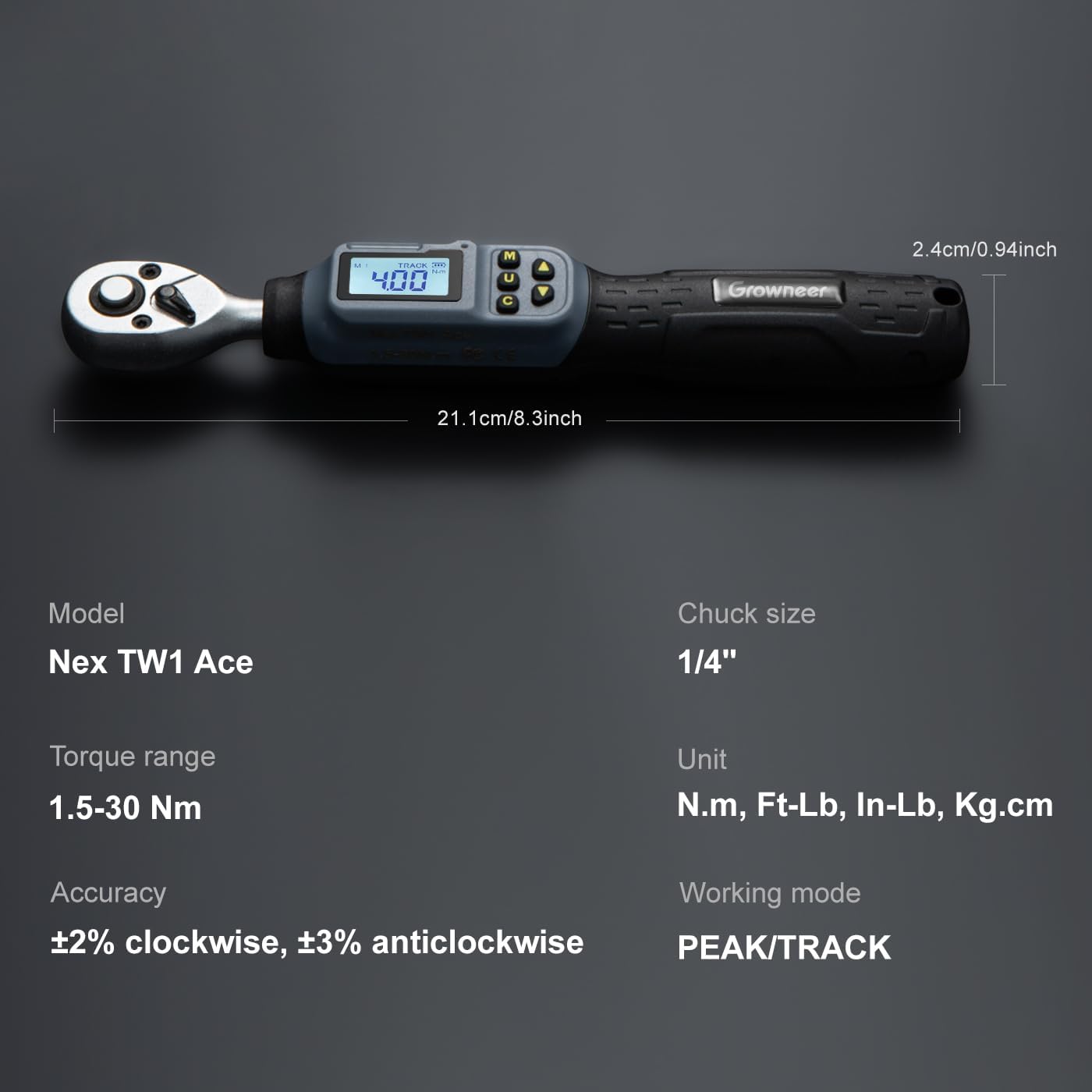
If you’ve ever snugged a bolt down on a carbon fiber handlebar and wondered, “was that tight enough — or too tight?”, you’ve already encountered the core problem this article is about. Torque is simply a measurement of rotational force — how hard you’re twisting a fastener. Bike manufacturers specify exact torque values (measured in Newton-meters, or Nm) for every bolt on the frame and components because too loose means the part slips or rattles loose, and too tight on modern lightweight materials means the part cracks or the threads strip. A click-style torque wrench (the most common kind, which makes an audible click when you hit the target torque) is rated at a certain accuracy — typically ±3% to ±4% of the target value. On a $40 stem bolt, that margin is fine. On a $3,500 Campagnolo Super Record EPS crankset or a Chris King threadless headset, that same margin starts to look like a gamble. This article breaks down exactly where the ±3% threshold falls short, what digital torque tools add to the picture, and how to match tool precision to build cost without over-spending on the wrench.
Why ±3% Feels Fine Until It Suddenly Isn’t
The ±3% accuracy rating on a click-style torque wrench sounds precise. In most mechanical contexts, it genuinely is. But on high-end bike builds, the math works against you in a specific, repeatable way.
Consider a carbon seatpost clamped by a frame manufacturer spec of 5 Nm — a number you’ll find in the Shimano Dura-Ace Di2 R9200 dealer’s manual (available via si.shimano.com) and in component-specific documentation from most UCI-level component brands. A ±3% wrench swinging at 5 Nm delivers somewhere between 4.85 Nm and 5.15 Nm in ideal conditions. That’s a 0.3 Nm window, and on paper it looks fine.
Here’s the problem: that ±3% figure is a manufacturer-rated best-case tolerance measured at a single calibration point, typically at 60–80% of the tool’s maximum range. Park Tool’s torque specifications guide explicitly notes that accuracy degrades toward the low end of a wrench’s rated range. A wrench rated for 2–24 Nm is least accurate near 2 Nm — exactly where the most fragile fasteners on a high-end build live. A stem face plate bolt on a Deda Zero or a 3T Integra system might spec at 3–4 Nm. A carbon saddle rail clamp can be as low as 2–3 Nm. You’re working at the ragged bottom edge of your tool’s reliable range.
Add in real-world variables — thread lubrication state, whether you’re using a torque-limiting extension, how the wrench is stored — and that ±3% rating is a ceiling, not a floor.
BikeRadar’s torque wrench buying guide (updated 2025) makes this point directly: accuracy at the low end of the range is the single most important variable for road and gravel builds dominated by carbon and titanium hardware, and it’s the variable most buyers ignore when spec-shopping on price alone.
What Digital Torque Wrenches Actually Add
A digital torque wrench replaces the click mechanism with a strain gauge and a readout — typically an LCD or LED display — that shows you live, real-time torque as you tighten. The key advantages over click wrenches are:
1. Continuous feedback, not a binary event. A click wrench tells you when you’ve hit the target. A digital wrench shows you the entire approach — so you can slow down as you get close, reducing overshoot. On soft materials like carbon, this approach curve matters. Owners of Wera’s digital torque wrench line consistently report that this graduated feedback changes how they work at low Nm values in ways a click wrench simply can’t replicate.
2. Tighter accuracy at low torque values. Premium digital tools (Wera, CDI, Norbar in the professional tier; Shimano’s own TL-FC41 for crank-specific work) are typically rated at ±2% or better across a wider percentage of their operating range. That’s not marketing copy — it’s a direct consequence of strain-gauge measurement being less dependent on spring preload mechanics.
3. Logging and peak-hold modes. Better digital units hold the peak reading after the wrench is removed, letting you verify and record the final value. For a shop maintaining multiple bikes — or a coach running a fleet of athlete bikes — this traceability is genuinely useful. VeloNews’s workshop tools deep dive (February 2025) noted that peak-hold functionality has become a baseline expectation among mechanics working on aero cockpits where disassembly-for-travel is frequent.
4. Angle measurement. Some digital models add a rotation-angle mode — particularly relevant for bottom bracket and crankset installation where torque-plus-angle sequences are specified. SRAM’s RED AXS service documentation (available at sram.com) and Shimano’s Hollowtech II installation procedures both reference angle-based tightening steps that a pure click wrench can’t confirm.
The Accuracy Math: By the Numbers
| Wrench Type | Rated Accuracy | At 5 Nm Target | Actual Range |
|---|---|---|---|
| Click wrench, ±4% | ±4% full range | 5 Nm spec | 4.80 – 5.20 Nm |
| Click wrench, ±3% | ±3% rated | 5 Nm spec | 4.85 – 5.15 Nm |
| Digital, ±2% | ±2% full range | 5 Nm spec | 4.90 – 5.10 Nm |
| Digital, ±1% (lab-grade) | ±1% rated | 5 Nm spec | 4.95 – 5.05 Nm |
At 5 Nm on a carbon fiber component with a typical failure margin of 20% above spec, the difference between ±4% and ±2% is real but survivable in most cases. At 2.5 Nm on a carbon saddle rail clamp — where the failure margin may be much tighter — the gap becomes meaningful. The 0.1 Nm improvement from ±2% to ±1% at this value is small in absolute terms but represents the difference between confidently staying in safe territory and statistically brushing against the edge.
Where the Money Decision Actually Lives
This is where practitioners tend to over-think and under-decide. Let’s put the tradeoff in plain terms.
A quality click wrench (Wera, Pedro’s, CDI) in the $150–$250 range gives you ±3% accuracy, durability, and tactile feedback most mechanics find natural. For aluminum components, steel-frame builds, and mid-range groupsets, this is the right tool and the right price. The Park Tool TW-5.2 (a well-regarded beam-style design) and the Pedro’s Demi Torque are frequently cited in CyclingNews’s pro mechanic workshop feature (March 2026) as the baseline professional standard.
A digital torque wrench in the $280–$450 range (Wera 7774, CDI 2502MRMHSS, or equivalent professional-grade units) makes sense when:
- You’re regularly torquing carbon cockpit components at values below 6 Nm
- You work on multiple bikes with different specs frequently enough that cross-contaminating muscle memory is a real risk
- You’re installing press-fit or threaded bottom brackets where preload precision affects bearing life
- You’re doing aero cockpit builds (integrated bars, Wahoo ELEMNT mount stacks, internal cable routing) where access for a re-torque is difficult after the build is closed up
A torque-limiting screwdriver set ($80–$180) — Wera’s Kraftform or the Vessel Ball Grip series — solves a problem digital wrenches don’t: the very small fasteners (1–3 Nm) on Di2 junction boxes, derailleur limit screws, and Garmin/Wahoo mounts. If you’re building a complete Dura-Ace Di2 system and you’re relying on a full-size torque wrench for the wire port covers, you’re using the wrong tool category entirely.
The full precision toolkit for a serious high-end build, then, isn’t one wrench — it’s a three-layer setup:
- Torque-limiting screwdrivers for sub-3 Nm fasteners
- Digital torque wrench (2–20 Nm range) for cockpit, seatpost, and derailleur hanger work
- Click wrench (10–60 Nm range) for BB, axle, and crank bolt work where high torque and tactile feel are appropriate
Calibration: The Hidden Cost Nobody Budgets For
Here’s the total cost of ownership item that most buyers skip entirely. A torque wrench — digital or click — loses calibration over time, through drops, through repeated use at the extremes of its range, and through storage under tension (a common mistake with click wrenches, which should always be stored at the lowest setting). The Park Tool Company’s torque specifications documentation recommends annual calibration checks for any torque wrench used in precision applications, with immediate recalibration after any drop.
Professional calibration services run $30–$80 per tool per year at certified metrology labs. A $400 digital wrench that’s calibrated annually for five years has a real 5-year cost of $550–$800. A $180 click wrench on the same schedule costs $330–$580 over five years. The gap narrows. If you’re running a small shop or maintaining a coach’s fleet, calibration cost-per-bike spreads that number out considerably — but the solo home builder should factor it in.
The practical shortcut: Wera and CDI both offer factory calibration certificates with their professional-tier tools, and both publish guidance on field verification using dead-weight reference loads. It’s not a substitute for lab calibration, but it’s a useful sanity check between annual services.
The Decision Rule
If X → then Y:
-
If you’re building or maintaining a single high-end road or gravel bike with a full carbon cockpit and a $2,000+ groupset → invest in a digital torque wrench in the $280–$400 range plus a torque-limiting screwdriver set. The total outlay of ~$400–$600 is appropriate relative to component value and failure cost.
-
If you’re a small-shop mechanic or coach maintaining 4+ bikes regularly → the digital wrench pays back in consistency and traceability. Budget for annual calibration as a line item. The CDI professional series or Wera 7774 range are the reference points most frequently cited by working mechanics in professional shop features on cyclingnews.com and velonews.com.
-
If you’re building steel or aluminum frames with conventional Shimano 105/Ultegra-tier components → a quality click wrench in the ±3% tier (Pedro’s, Park Tool, Wera click-torque) is the right match. You’re not working at low enough torque values, with expensive enough carbon hardware, or at tight enough tolerances to justify the premium.
-
If you’re doing suspension setup on RockShox or Fox forks → the relevant torque values (crown race, steerer clamp, damper adjuster) are high enough and tolerance-wide enough that a calibrated click wrench is fully appropriate. The digital advantage is minimal in this context.
The wrench is part of the build. Match its precision to the precision the components actually demand — not to the most impressive spec sheet in the catalog.