E-Bike Tool Compatibility: What Standard Bike Tools Get Wrong on Motor and Battery Builds
If you’ve wrenched on regular bicycles for a few years, picking up an e-bike conversion or repair job feels like it should be straightforward. An e-bike (electric bicycle) is, at its core, still a bike — it has a chain, cassette, wheels, and brakes. But layered on top of that familiar skeleton is a motor, a battery pack, and a wiring harness, and those additions quietly break the assumptions baked into your existing toolbox. The center hole on your chain whip may be too small to clear a hub motor cable. Your trusty 3/8-inch drive torque wrench might not resolve finely enough to safely tighten a lithium battery cell fastener. And the chain master links that ship with budget chain kits — perfectly acceptable on a standard drivetrain — become a real liability under mid-drive motor torque.
This guide is written for mechanics who already know their way around a workshop but are encountering e-bike-specific jobs with increasing frequency. We’ll map the exact points where standard tools fail, explain the reasoning behind each, and give you clear decision rules for upgrading your kit.
| EDITOR'S PICKGROWNEER Digital Torque Wrench | Mid-tierEPAuto Bike Tool 1/4 Inch Drive… | Budget pickOumers Bike Cassette Removal To… | |
|---|---|---|---|
| Torque range | 1.5–30 Nm | 2–20 Nm | — |
| Drive size | 1/4" | 1/4" | — |
| Wrench type | Digital | Click | — |
| Alert | Buzzer + LED | Click | — |
| Bits/sockets | ✓ | ✓ | — |
| Cassette tool | — | — | ✓ |
| Price | $74.39 | $34.97 | $17.29 |
| See on Amazon → | See on Amazon → | See on Amazon → |
The Chain Whip Center Hole Problem Nobody Talks About
This is the single most underreported compatibility issue in e-bike workshop work, and it will stop a job cold if you’re not prepared for it.
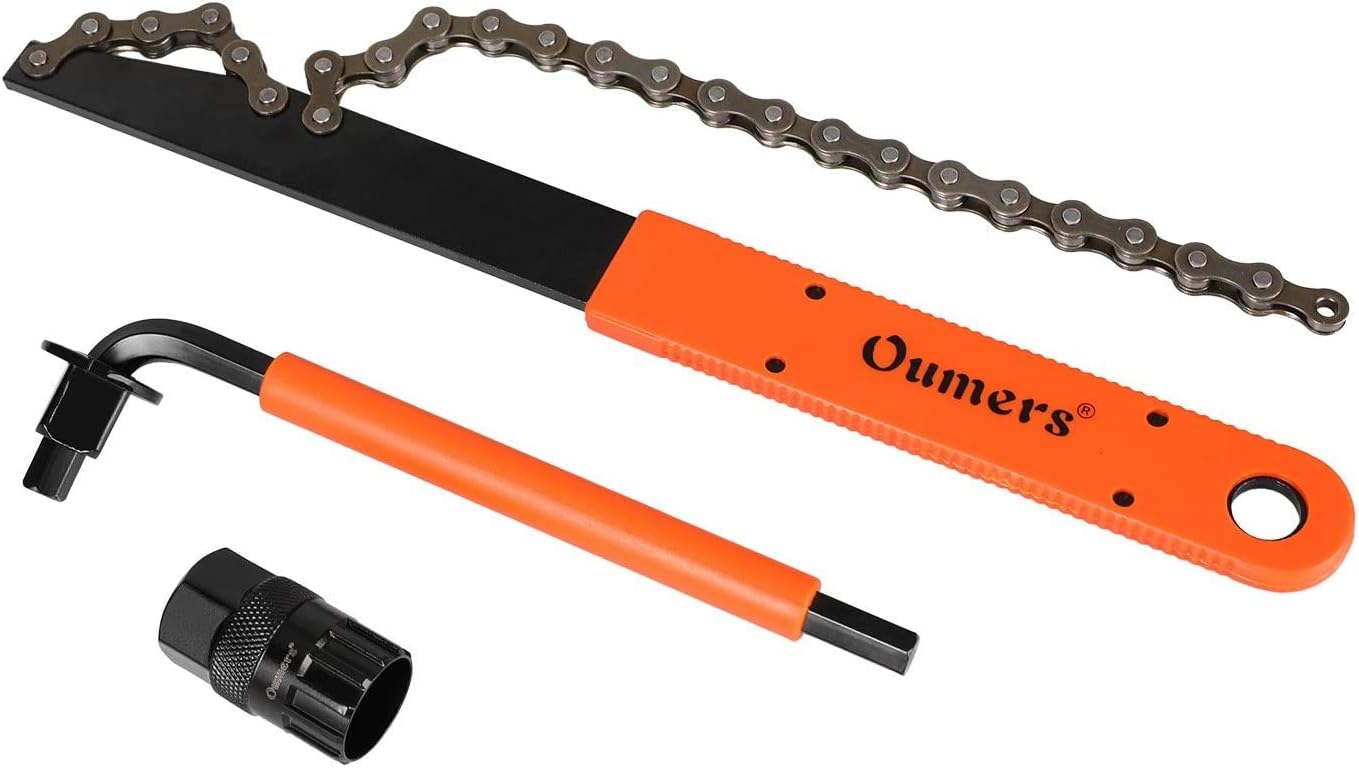
A chain whip is the tool you hook over a cassette (the cluster of gears on the rear wheel) to hold it still while you loosen the lockring. Every chain whip has a center hole — the opening you slip over the freehub body. On a conventional rear wheel, that hole only needs to clear the axle and freehub. On a hub-motor e-bike (where the electric motor lives inside the rear wheel hub), the motor cable exits through that same axle area and routes inward. The cable diameter is meaningfully larger than a standard axle, and if your chain whip’s center hole isn’t sized to clear it, you simply cannot seat the tool properly.
This failure mode is consistent across hub motor e-bikes from manufacturers including Bafang and Shimano STEPS rear-drive variants, as well as most conversion kit builds — all of which route cables through the axle in ways that a standard chain whip wasn’t designed to accommodate. Sheldon Brown’s documentation on cassette removal and cog mechanics, available at sheldonbrown.com, provides useful background on how freehub interfaces are structured and why axle clearance matters during cassette service — context that translates directly to understanding why hub motor cable routing creates this problem.
The decision rule here is simple: Before any cassette work on a hub-motor e-bike, measure the cable diameter at the axle exit point (typically 8–12 mm including the cable housing). If your chain whip’s center hole is smaller than that diameter plus a few millimeters of clearance, you need a replacement before you start — not halfway through. Source a chain whip documented to have a larger-bore center hole; some cassette removal kits are explicitly designed with hub motor clearance in mind, and that specification should appear in the product documentation before you buy.
Torque Precision: Why the Range on Your Current Wrench May Not Be Enough
Torque wrenches control how tightly fasteners are tightened — critical because over-tightening can crack components and under-tightening causes them to loosen under load. On a standard road or mountain bike, most fasteners fall between 4 Nm (small stem bolts) and 50 Nm (bottom bracket cups), and a decent click-style torque wrench covers that band reliably.
E-bike builds add two categories of fasteners that pressure-test those assumptions at both ends of the range:
Low end — battery compartment fasteners. Lithium-ion battery cell fasteners on many e-bike systems are specified at 3–6 Nm — a precision requirement that many mid-range click wrenches either don’t reach or handle imprecisely at the bottom of their scale. Click wrenches are notoriously inaccurate in the lowest 20% of their rated range. A wrench rated 10–150 Nm used at 5 Nm is working well below its reliable threshold. Digital torque wrenches with audible and LED alerts address this directly, and mechanics who work across multi-fastener battery assembly tasks consistently report that feedback-based wrenches reduce the cognitive load of tracking each bolt — e-bike motor and battery work fits that profile exactly.
High end — motor mount bolts. Mid-drive motors — including the Bosch Performance Line, Shimano EP8, and Brose Drive S — mount to the bottom bracket shell with bolts that manufacturers typically specify at 8–50 Nm depending on bolt size and location. Per Shimano’s technical documentation for the STEPS EP8 system, published through Shimano’s service information portal at si.shimano.com, motor unit fixing bolts are specified across a range from smaller bolts at 8–10 Nm up to 30 Nm for the main mount fasteners. That span demands precision across a wide range — more than any single click wrench typically manages well at both extremes.
By the Numbers
| Fastener Type | Typical Torque Spec | Standard Wrench Risk |
|---|---|---|
| Battery cell / BMS fasteners | 3–6 Nm | Below reliable range on most click wrenches |
| Motor cable routing clamps | 2–4 Nm | Same problem |
| Mid-drive motor mount bolts | 8–30 Nm | Within range but verify lower bound |
| Cassette lockring (e-bike) | 40–50 Nm | Standard range, no issue |
The practical upgrade path: a digital torque wrench covering the 1–25 Nm range for battery and small motor fasteners, alongside your existing click wrench for mid-to-high spec work. Running two purpose-fit wrenches is a modest investment relative to the cost of a battery management board or motor unit damaged by under- or over-torquing.
Chain and Drivetrain: Where Budget Parts Become a Safety Question
On a standard acoustic bike (one without a motor), a slightly underspecified master link in a budget chain kit is a nuisance — maybe a dropped chain, maybe a roadside repair. On a mid-drive e-bike, it’s a different risk calculation entirely.
Mid-drive motors apply torque directly to the drivetrain — the chain, chainring, and cassette all absorb the combined output of your legs and the motor simultaneously. Shimano EP8 and Bosch Performance Line CX units both produce 85 Nm of motor torque at the crank, which translates to substantially higher chain tension than any rider generates alone. A master link rated for acoustic bike loads may be operating near its design limit under sustained mid-drive assist. The right specification matters: Shimano, SRAM, and KMC all produce chains rated explicitly for motor-assisted use, with reinforced pins and plates designed for higher sustained tension loads.
According to Park Tool’s chain wear and replacement guide, published at parktool.com, e-bike chains should be checked for stretch more frequently than standard chains — most practitioners treat 500–800 km as the inspection interval rather than the 1,500–2,000 km intervals common on acoustic bikes. BikeRadar’s drivetrain wear testing coverage, published at bikeradar.com, documents that e-bike chains can wear two to three times faster under motor-assisted conditions, particularly in high-assist modes on hilly terrain.
The tool implication: your chain wear indicator (a simple go/no-go gauge that slides into chain links to measure elongation) should be in your hand more frequently, and the chains you install should meet e-bike-specific standards. Don’t substitute a standard chain because it’s in stock. Sheldon Brown’s documentation on chain mechanics at sheldonbrown.com provides useful background on why link integrity matters under sustained tension loads — the physics of chain elongation under load apply with greater consequence on motor-assisted drivetrains.
SRAM’s Eagle Transmission service documentation, available at sram.com, additionally notes that AXS e-bike-rated components use different clutch and chain specifications than the acoustic Eagle lineup — a detail that catches mechanics who assume component interchangeability across the SRAM catalog. If you’re specifying parts for an e-bike build and pulling from a SRAM catalog, confirm the AXS variant rather than the acoustic equivalent.
Cassette Tool Compatibility: Standard HG vs. E-Bike Freehubs
Standard Shimano HG cassette lockring tools work fine on most e-bike rear wheels — as long as the freehub body uses HG spline interface. But hub motor e-bikes increasingly ship with micro-spline freehubs (to accept 12-speed cassettes) or proprietary interfaces from motor manufacturers, and HG tools won’t engage those correctly.
Before assuming tool compatibility, confirm the freehub interface on the specific wheel you’re servicing. Park Tool’s freehub compatibility documentation, maintained at parktool.com, is a reliable reference and is updated as new interfaces enter the market. The cost of the wrong tool is a stripped lockring — and on a hub motor wheel, that can mean a repair bill that dwarfs the cost of buying the correct tool before you start.
Frequently Asked Questions
How do I know if a chain whip’s center hole is large enough to clear my e-bike hub motor cable?
Measure the outer diameter of the cable housing where it exits the axle — use a digital caliper for accuracy. You want at least 2–3 mm of clearance beyond that measurement. Most hub motor cables run 8–12 mm in diameter. Standard chain whip center holes are typically sized for a bare axle with minimal clearance, so the margin disappears quickly once cable housing is factored in. If in doubt, source a chain whip with a documented larger center hole before starting the job.
What torque wrench range do I need to cover both battery compartment fasteners and motor mount bolts on a mid-drive e-bike?
No single wrench covers the full range well. Battery and BMS fasteners run 3–6 Nm; motor mount bolts run 8–30 Nm on most systems per Shimano’s STEPS EP8 service documentation at si.shimano.com. A digital wrench in the 1–25 Nm range handles the low end with accuracy; a standard click wrench in the 10–60 Nm range covers motor mounts. Two purpose-fit tools cost far less than a battery management board you’ve stripped.
Can I use standard Shimano HG cassette tools on an e-bike rear hub?
Sometimes yes, sometimes no — it depends on the freehub interface. HG tools work on HG spline freehubs, which remain common on many e-bike builds. Micro-spline freehubs (used with 12-speed cassettes) require a micro-spline lockring tool. Hub motor proprietary interfaces may need manufacturer-specific tooling. Check the freehub type before pulling the cassette; Park Tool’s freehub compatibility documentation at parktool.com covers the current interface landscape.
Do e-bike chains wear faster than standard chains, and should I check them more often?
Yes, meaningfully faster. BikeRadar’s drivetrain wear testing documentation at bikeradar.com records e-bike chains wearing two to three times faster than acoustic bike chains under motor-assisted conditions. Park Tool’s chain wear and replacement guide at parktool.com recommends checking chain wear every 500–800 km on e-bikes. Use a chain wear indicator and act on 0.5% stretch on e-bike drivetrains — don’t wait for the 0.75% threshold sometimes applied to acoustic bikes.
Are reinforced e-bike chain links compatible with standard master link pliers?
Generally yes — the plier mechanism engages the link geometry, and most reinforced e-bike master links use standard outer-plate dimensions. The exception is some proprietary chain systems, notably SRAM Flattop used on AXS road drivetrains, which require a specific link and plier orientation per SRAM’s Eagle Transmission service documentation at sram.com. If you’re working with a non-standard chain spec, confirm master link geometry before assuming your existing pliers will seat and release the link cleanly.
The Bottom Line: Clear Decision Rules for Your Kit Upgrade
Working through the compatibility issues above, three upgrade decisions cover the majority of e-bike workshop situations:
-
If you’re doing cassette work on any hub-motor e-bike: Verify chain whip center hole clearance against your cable diameter before starting. If it’s marginal, replace the whip — it’s a modest tool cost, not a motor replacement cost.
-
If you’re doing battery or motor mount work: Add a digital torque wrench with sub-10 Nm precision to your kit. Your existing click wrench handles the upper range; the digital tool covers the sensitive low-end fasteners where click wrenches are unreliable.
-
If you’re sourcing chain and master links for a mid-drive build: Specify e-bike-rated chains from Shimano, SRAM, or KMC and inspect chain wear at 500–800 km intervals, not acoustic-bike intervals. A worn chain on a mid-drive accelerates cassette wear dramatically — the total cost of ignoring the interval is much higher than the cost of catching it early.
The investment in e-bike-specific tooling is modest relative to the cost of the components you’re protecting. The bikes themselves are often $3,000–$8,000 builds. The tools that service them correctly are a fraction of that — and the tools that don’t fit correctly aren’t savings at all.