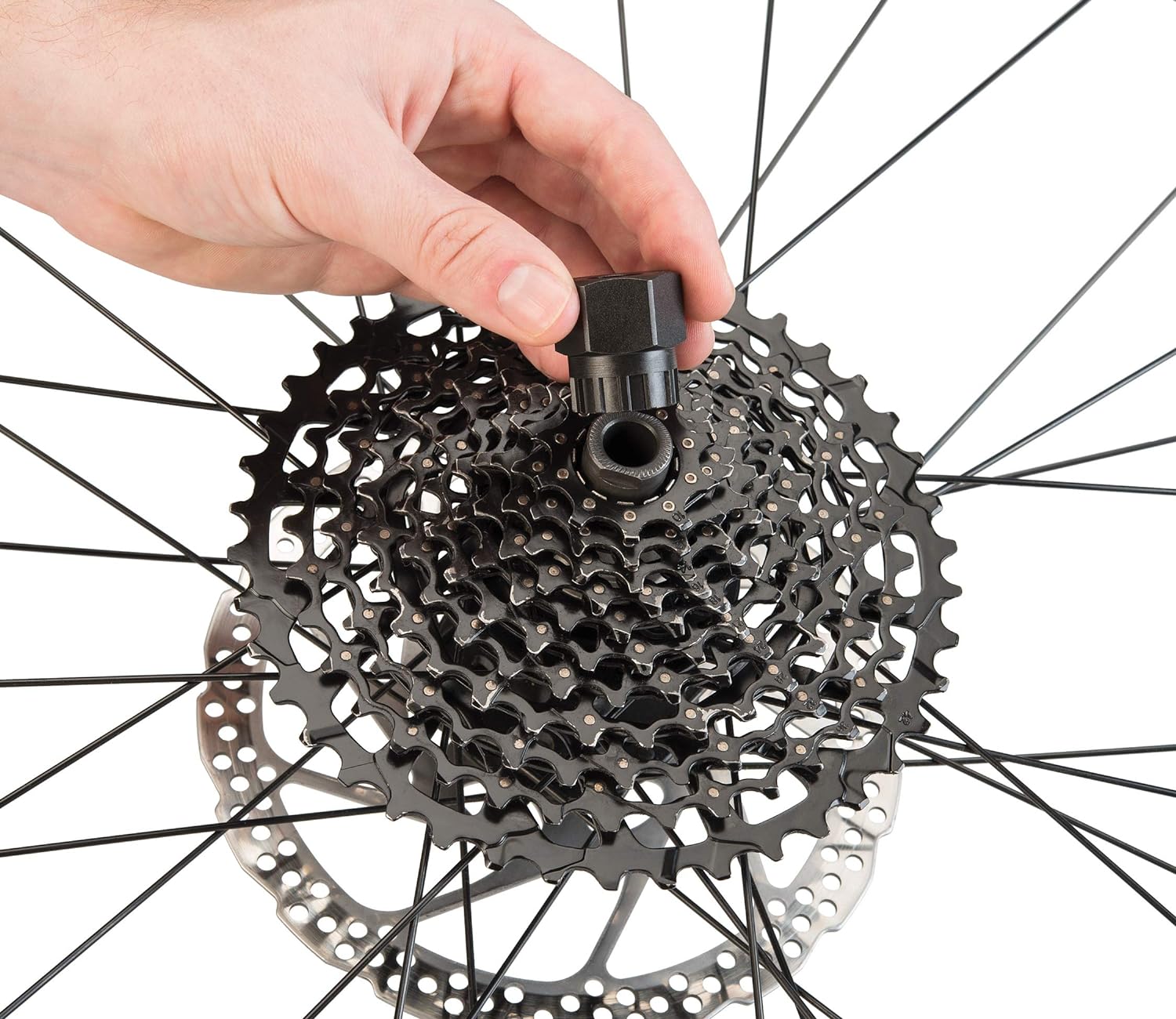
Your rear wheel does a job most riders never think about until something goes wrong. Inside the hub — the central cylinder the wheel spins around — there’s a small mechanism called a freehub body: a ratcheting sleeve that lets you coast without pedaling and engages when you push the cranks. The cassette (the stack of sprockets on the right side of your rear wheel) slides onto that freehub body and is held in place by a single lockring — a threaded collar you unscrew to pull the cassette off.
Swapping cassettes, regreasing a freehub, or replacing a worn freehub body entirely are jobs that belong in any intermediate home mechanic’s rotation. But they require a precise set of tools, and the gaps in a typical starter kit — a wrong-diameter hole here, a missing Allen key there — are exactly where jobs stall. This guide maps out the full toolchain, names the real-world compatibility traps reviewers keep hitting, and ends with a clean decision rule so you know exactly what to buy before the wheel comes off the bike.
What’s Actually Happening When You Service a Freehub
Let’s separate two jobs that get conflated:
Job 1: Cassette removal. You’re just pulling the sprocket stack off the freehub body to clean it, replace worn cogs, or swap gearing. This requires a lockring tool (which engages the splined lockring at the center of the cassette) and a chain whip (a length of chain on a handle that grips one of the sprockets to prevent the cassette from spinning while you break the lockring loose).
Job 2: Freehub body removal. You’re going deeper — pulling the entire freehub mechanism out of the hub shell to regrease the pawls and spring system, replace a damaged freehub, or swap for a different driver standard. On most Shimano hubs, this requires a large Allen wrench — typically 10mm — threaded into a bolt at the non-drive side of the axle. On some hubs it’s an 8mm or 12mm Allen; Shimano’s published service instructions (si.shimano.com) list the correct size per hub model. Campagnolo’s interface is different, and we’ll get to that.
The distinction matters because you don’t always need both jobs. A cassette swap only requires the lockring tool and chain whip. Full freehub removal adds the Allen wrench step. Conflating them is how riders buy an incomplete kit and end up improvising.
The Hidden Torque Problem
Lockrings are torqued to 40 Nm on most Shimano systems — moderate, but enough that breaking them loose by hand with a short tool handle is genuinely difficult. Park Tool’s repair documentation notes that using a long-handled lockring tool or adding a breaker bar dramatically reduces the effort required. This is also why review communities consistently flag the handle variant of lockring tools as worth the small price difference for solo mechanics without a bench vise.
The Tool Stack — And Where Each One Can Fail You
The Chain Whip
The chain whip’s job is simple: hold the cassette from rotating while you apply counterclockwise torque to the lockring. Most chain whips are universal across 7- through 12-speed cassettes. The failure point reviewers keep hitting is the center hole.
On the Oumers chain whip kit, owners have flagged in aggregated reviews that the center hole diameter is too small to fit over a larger e-bike axle — meaning the tool physically can’t seat flat against the cassette face on some hub designs. Reviewers note that an older chain whip included in the same kit happened to fit, which is more luck than design. If you’re servicing an e-bike rear hub with a thicker 12mm or 15mm through-axle, verify the center hole diameter of any chain whip before you buy. This is the kind of spec that rarely appears on product pages but shows up consistently in owner feedback.
The Lockring Tool
Park Tool’s FR-5.2 is the reference-grade lockring tool for Shimano cassettes, with a 12-notch splined interface that engages the lockring securely. Owners report it works cleanly with a standard 1/2-inch drive breaker bar — a point worth confirming, because not every lockring tool shares the same drive interface. The FR-5.2 has a center hole that reviewers describe as accommodating hub axles cleanly on most setups.
The FR-5.2H is the same tool with an integrated T-handle already attached. Owners specifically praise the FR-5.2H’s wider inner hole as an advantage on through-axle wheels, where the lockring tool must seat over a larger-diameter axle without binding. If you’re working on a bike with 12mm thru-axle hubs — which covers most modern road and gravel bikes — the FR-5.2H’s fitment advantage is real and worth factoring in.
By the numbers:
- Shimano lockring torque spec: 40 Nm (per Shimano service instructions)
- Typical through-axle diameter: 12mm road/gravel, 12mm or 15mm MTB
- FR-5.2 drive interface: 1/2-inch square drive (breaker bar compatible)
- FR-5.2H: integrated T-handle, wider center bore
The Allen Wrench for Freehub Body Removal
This is where most cassette service kits stop short. Cassette removal (just pulling the sprocket stack) doesn’t need an Allen wrench. Full freehub body removal on Shimano hubs typically requires a 10mm Allen key — a size that shows up in almost no general-purpose Allen set because it’s uncommon outside hub work. Reviewers of the Oumers chain whip kit have specifically noted the missing 13mm Allen wrench as a meaningful gap, calling it something they’d have paid extra to have included. (Note: the specific size required varies by hub; Shimano’s service instructions at si.shimano.com list the correct size per hub model, so always verify before buying.)
If you’re sourcing tools to cover freehub body removal, check your hub’s service manual first, then build your kit around the confirmed Allen size. A standalone Wera or Pedro’s hex key in the correct size is a better investment than a set that goes up to 8mm.
The BBT-5/FR-11 Combo Tool (For Campagnolo Users)
Park Tool’s BBT-5/FR-11 is a combination tool that handles both Campagnolo bottom bracket cups and Campagnolo cassette lockrings — the latter via the FR-11 end, which has the correct splined interface for Campagnolo’s proprietary lockring design. Owners report this tool works cleanly for Campagnolo cassette swaps, which is notable because this use case isn’t prominently advertised on the tool itself. If you’re running a Campagnolo Super Record or Record groupset, this is the lockring solution — the Shimano-pattern FR-5.2 will not engage Campagnolo’s lockring correctly.
The Full Workflow, Step by Step
Cassette removal only:
- Remove the wheel from the bike.
- Seat the lockring tool (FR-5.2 or FR-5.2H for Shimano; FR-11 end of BBT-5/FR-11 for Campagnolo) into the lockring splines.
- Wrap the chain whip around a mid-cassette sprocket (holding it clockwise from the drive side).
- Apply counterclockwise torque to the lockring tool while the chain whip prevents the cassette from spinning. A 1/2-inch breaker bar gives significant mechanical advantage here.
- Once the lockring breaks free, unthread it by hand, then slide the cassette off. Note the spacers.
Adding freehub body removal (Shimano):
- Complete cassette removal above.
- Flip the wheel to access the non-drive side of the axle.
- Insert the correct Allen key (verify size from Shimano’s service instructions for your specific hub model) into the hollow axle bolt at the non-drive side.
- Thread counterclockwise to unscrew the freehub retention bolt.
- Slide the freehub body off the hub shell. Service (regrease pawls, replace freehub), then reinstall in reverse, torquing the retention bolt per Shimano’s spec.
Sheldon Brown’s documentation at sheldonbrown.com notes that some older Shimano hubs use a different interface — and that the freehub on certain models can be removed with the axle still in place, while others require partial axle disassembly. Always confirm against your hub’s documentation before starting.
BikeRadar’s cassette replacement guide echoes a point worth reinforcing: the chain whip direction matters. The chain whip should engage the cassette so that when you pull the whip handle toward you, the cassette is resisted from spinning counterclockwise (which is the direction the lockring unthreads). Getting this wrong means you’re fighting your own tools.
Frequently Asked Questions
Do I need a chain whip if I’m using a lockring tool? For cassette removal, yes — with one narrow exception. Some mechanics have developed techniques using a zip tie or the bike’s own drivetrain resistance to hold the cassette, and Park Tool’s documentation acknowledges that removing the wheel while leaving the chain engaged on the cassette can sometimes substitute. But for reliable torque and safety on a standalone wheel, a proper chain whip is the right answer. The “chain whip bypass” techniques you’ll find documented in various cycling forums are workarounds, not standard practice.
Will the Oumers chain whip kit fit my e-bike hub axle? Not reliably. Owners have reported that the center hole on the Oumers chain whip is too small to fit over larger e-bike axles. If your e-bike uses a larger through-axle, verify center-hole diameter before purchasing any chain whip. The FR-5.2H from Park Tool has been specifically noted by owners for its wider inner bore, which handles through-axle fitment better.
What size Allen wrench do I need to remove a Shimano freehub body? The most common size is 10mm, but this varies by hub model. Shimano’s published service instructions at si.shimano.com list the correct specification for each hub. Always verify before buying; some hubs use 8mm or 12mm.
Can I use the FR-5.2 with a standard 1/2-inch drive breaker bar? Yes. The FR-5.2 has a 1/2-inch square drive recess, and owners confirm it pairs directly with a 1/2-inch breaker bar. This gives useful mechanical advantage when breaking a fully torqued lockring loose without a bench vise.
What’s the difference between the FR-5.2 and the FR-5.2H with handle? The FR-5.2 is the tool head only — you supply a breaker bar or ratchet. The FR-5.2H adds an integrated T-handle and, importantly, owners report a wider center bore that accommodates through-axle hubs more cleanly. For through-axle bikes, the FR-5.2H’s fitment advantage is worth the small additional cost.
Does the BBT-5/FR-11 work for Campagnolo cassettes? Yes. The FR-11 end of the Park Tool BBT-5/FR-11 combo is designed for Campagnolo’s lockring pattern, and owners confirm it works correctly for Campagnolo cassette removal. This use case isn’t prominently marketed, but the tool is the correct solution for any Campagnolo cassette swap.
The Decision Rule
If you’re doing cassette swaps only on a standard quick-release or thru-axle road/gravel bike: the FR-5.2H (for its wider bore) plus a quality chain whip covers the job. Verify the chain whip’s center hole fits your axle before buying.
If you’re doing full freehub body service on Shimano hubs: add the correct Allen key for your specific hub (confirm at si.shimano.com) — this is almost certainly not in your existing kit.
If you’re running Campagnolo: the BBT-5/FR-11 is the correct lockring tool; Shimano-pattern tools will not engage properly.
If you’re servicing e-bike hubs: axle diameter is your first filter. Check the center hole spec of every tool in your chain before purchasing, or budget for a return.
The tool cost for a complete cassette-service kit — lockring tool, chain whip, breaker bar, correct Allen key — is well under the labor rate for a single shop visit. For anyone maintaining a high-investment wheel build, the math strongly favors owning the kit.