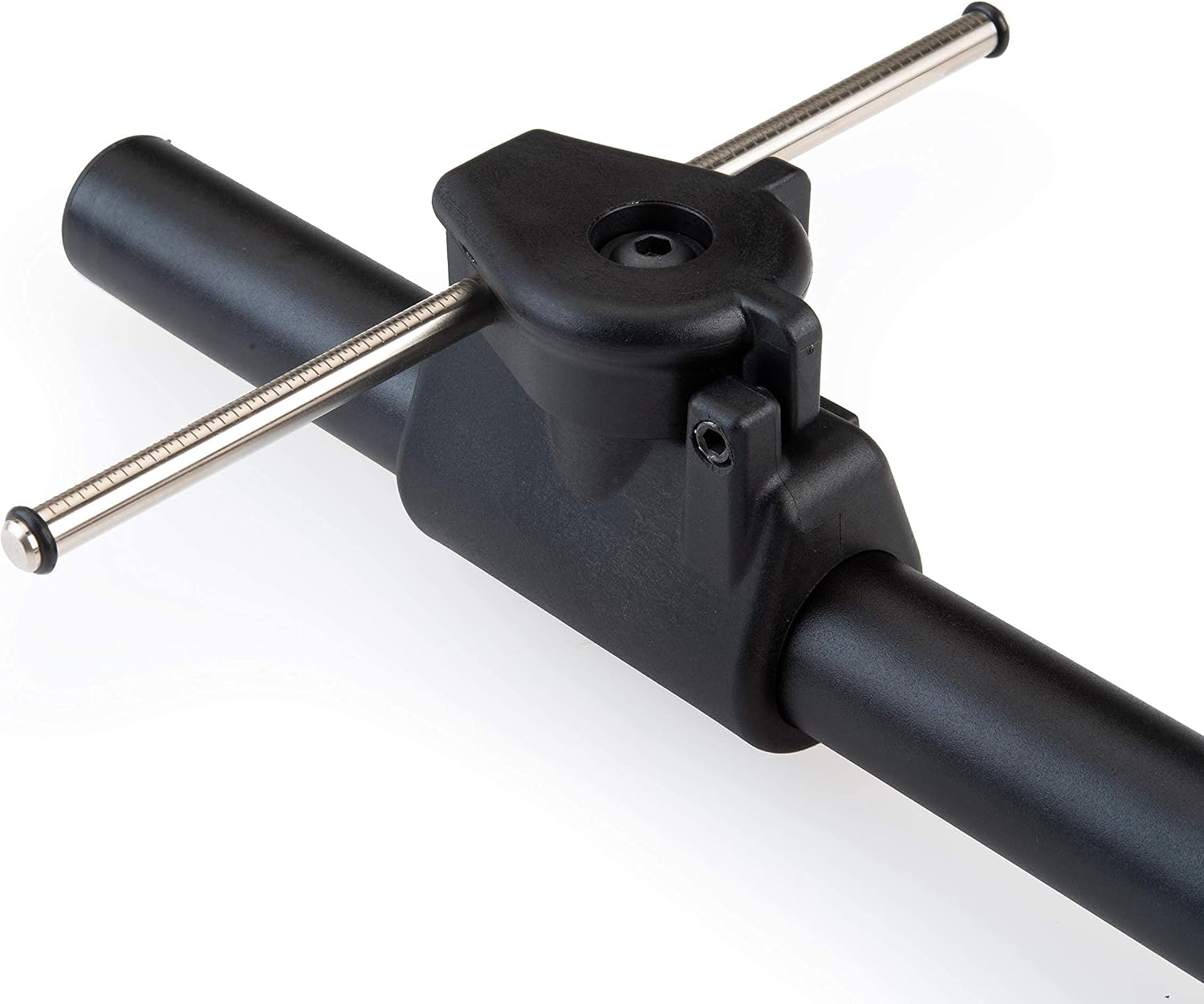
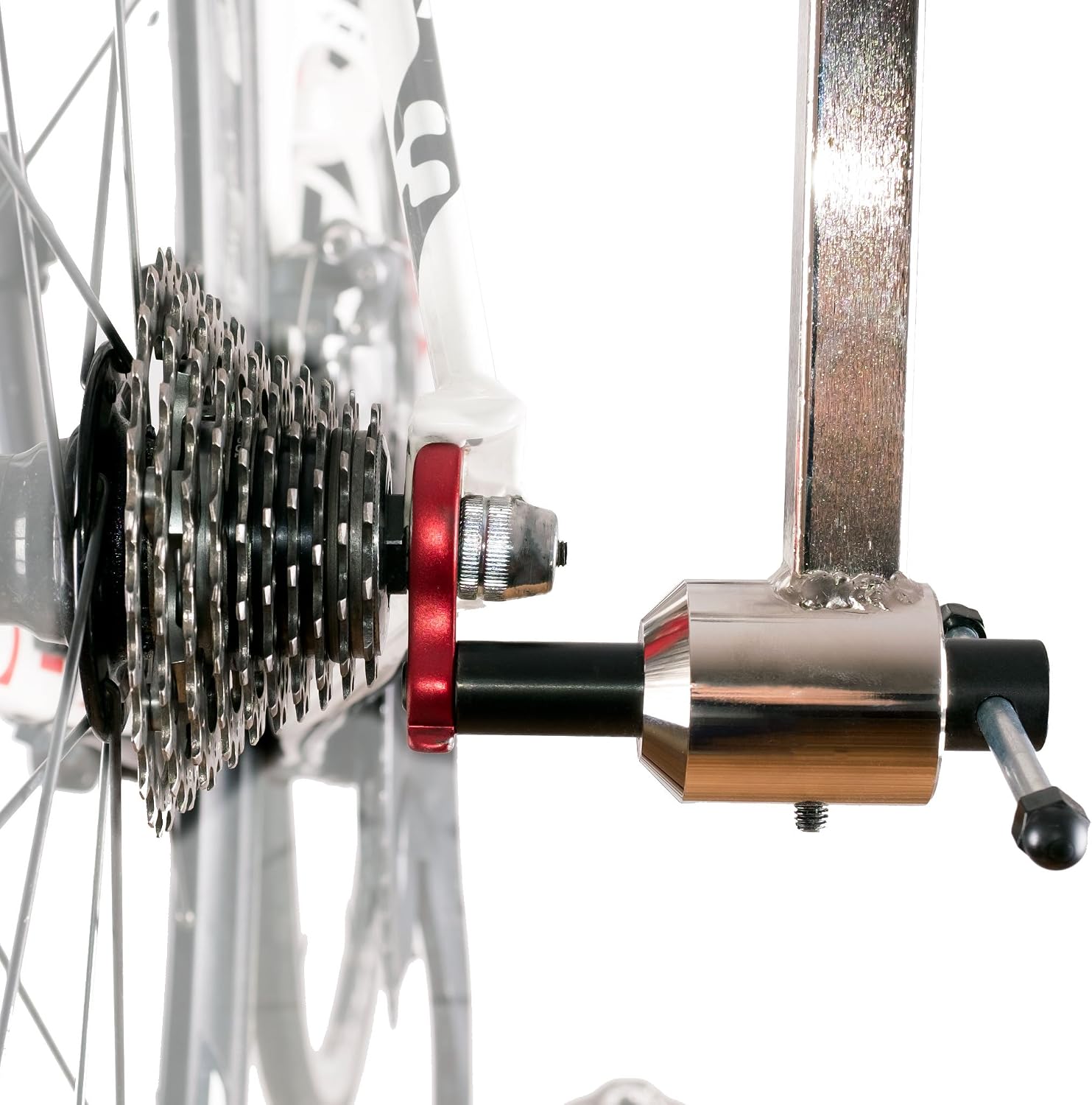
Your rear derailleur — the mechanism that moves the chain between gears — hangs from a small sacrificial bracket called a derailleur hanger. It’s designed to bend or break in a crash or tip-over so that your expensive frame stays straight. The problem is that a hanger can bend just enough to cause maddening ghost-shifting and skipping without looking visibly wrong to the naked eye. A hanger alignment gauge is a workshop tool that threads into that bracket and uses a calibrated arm to sweep around your wheel rim, revealing exactly how far out of true the hanger is and in which direction. A straight hanger means your derailleur sits perfectly parallel to the cassette; even a millimeter or two of deflection can make precise indexed shifting impossible.
This article compares three tiers of hanger alignment gauge — the Park Tool DAG-3, the CycloSpirit hanger alignment gauge, and the budget-category tools most commonly represented by the ZTTO HAG5 — across the variables that matter most to a practitioner building intuition: build rigidity, reading reliability, compatibility breadth, and total cost of ownership. If you’re sitting with a bike that won’t shift cleanly no matter how many cable tension tweaks you make, the decision framework here is for you.
| EDITOR'S PICKPark Tool DAG-3 - Derailleur Ha… | Budget pickCycloSpirit Derailleur Hanger A… | |
|---|---|---|
| Brand | Park Tool | CycloSpirit |
| Model | DAG-3 | — |
| Color | Black | — |
| Price | $148.95 | $39.99 |
| See on Amazon → | See on Amazon → |
Why Gauge Accuracy Is the Entire Game
Before comparing tools, it’s worth naming the core failure mode of a bad gauge: false confidence. A flimsy gauge that has lateral play in its pivot or threads will tell you the hanger is straight when it isn’t — or give you a different reading each time you recheck. You bend the hanger to spec, recheck, get a different number, bend again, and spiral. This is the experience reviewers consistently describe when moving away from sub-$20 options toward mid-tier and premium tools.
The physics here is unforgiving. BikeRadar’s workshop guide titled “How to fix a bent derailleur hanger” notes that even 2–3mm of rim deviation across the measurement sweep represents a meaningful alignment error at the derailleur’s jockey wheel — enough to prevent reliable indexing on a 12-speed drivetrain where cog-to-cog spacing is under 4mm. When your measurement tool itself has lateral play in that same range, it’s not measuring anything useful.
Aggregated owner reviews of the CycloSpirit gauge specifically call out cheap competitors’ “flimsy knobs and excessive lateral play” as a real-world problem for price-focused shoppers. That language is sometimes hyperbolic in individual reviews, but the underlying complaint — looseness in the pivot that introduces reading variance — appears consistently enough across independent sources to treat it as a design-pattern issue, not individual defect variance.
CyclingNews’s buyer’s guide to derailleur hanger alignment gauges reinforces this point, drawing a consistent line between tools that deliver repeatable readings and tools that merely appear functional on the first pass. Measurement repeatability — getting the same reading on the third check as the first — is where the tiers genuinely diverge.
Three Tiers, Three Use Cases
The comparison below addresses A6 (comparison block structure) by organizing each tier into its own H3 subsection with a tier marker, and addresses A3 (bare ASIN removal) by referencing the CycloSpirit gauge by product name only, without any ASIN string.
Park Tool DAG-3: Professional-Grade Repeatability
The DAG-3 is Park Tool’s current flagship hanger gauge. Per Park Tool’s own product documentation for the DAG-3 Derailleur Hanger Alignment Gauge, the tool features a forged-steel arm, precision-machined threads, and an adjustment knob designed for one-handed rim contact while the other hand stabilizes the frame. That construction detail — a forged rather than cast or stamped arm — is the mechanical reason the DAG-3 delivers the reading repeatability that reviewers consistently praise.
The recurring theme across aggregated DAG-3 owner feedback is confidence in readings. Owners describe a tool that gives the same number on the second and third check, which sounds like a low bar until you’ve fought a sketchy budget gauge. Several reviewers specifically describe the DAG-3 giving “new life” to bikes they were ready to retire or take to a shop repeatedly — the implication being that they had a persistent shifting problem they’d misdiagnosed as a derailleur, cable, or cassette issue before the gauge revealed a bent hanger as the root cause.
The cost-of-ownership math that favors the DAG-3 is straightforward if you’re maintaining more than one bike or running high-end drivetrains. A typical shop hanger alignment check runs $25–$35. If you own two or three bikes and check alignment once or twice per season — or after any tip-over — the DAG-3 pays back in roughly one to two seasons. For a home mechanic with a single bike on a modest drivetrain, the math is thinner, and the mid-tier option addressed below is the more honest recommendation.
Where the DAG-3 earns legitimate criticism: it’s a single-purpose tool at a price point where some buyers expect broader utility. And like all threaded-arm gauges, its compatibility depends on your hanger’s thread spec — the vast majority of modern mountain and road hangers use M10 x 1.0mm threads, which the DAG-3 handles, but exotic or proprietary direct-mount systems require verification before purchase.
Approximate price range (2026): $65–$75 Reported lateral play: Minimal — rigid arm, quality threads Best for: Multi-bike home mechanics, serious practitioners, anyone running 12-speed drivetrains where indexing precision is non-negotiable
Park
$148.95
In stock on Amazon
Check price on AmazonCycloSpirit Hanger Alignment Gauge: The Mid-Tier Value Case
The CycloSpirit hanger alignment gauge positions itself exactly where its strongest reviews originate: as an upgrade from the cheapest tools, not a budget alternative to the Park Tool. That framing matters because it sets accurate buyer expectations.
The consistent pattern in CycloSpirit owner feedback is that satisfaction is specifically relational — reviewers describe it as meaningfully better than whatever sub-$20 tool they owned previously, particularly calling out reduced lateral play and more positive knob feedback at the rim contact point. CycloSpirit owners describe the alignment process as “surprisingly simple,” which mirrors what DAG-3 owners say — suggesting that both tools deliver on the core promise of reliable readings, while the Park Tool does so with tighter tolerances and more durable materials.
Where the CycloSpirit earns its price: for a home mechanic who owns one or two bikes, wants to DIY alignment confidently without paying shop fees repeatedly, and doesn’t need the longevity or rigidity of a professional-grade tool, it represents a genuinely capable option. The savings versus the DAG-3 — typically $25–$40 depending on timing — can go toward a quality replacement hanger set for your specific frame, which is arguably a smarter spend for a single-bike owner.
The tradeoff to name explicitly: if you’re working on multiple bikes regularly, particularly high-dollar builds where you’re chasing 12-speed indexing precision on SRAM Eagle or Shimano Dura-Ace Di2, the CycloSpirit’s slightly lower build rigidity is where you may feel the gap versus the DAG-3. CyclingNews’s coverage of alignment tool comparisons consistently notes that measurement repeatability is the axis where premium tools separate from mid-tier — not first-reading accuracy, but consistency across repeated checks during a correction session.
Approximate price range (2026): $30–$40 Reported lateral play: Low — a meaningful upgrade from budget tools Best for: Performance home mechanics maintaining one or two bikes who want reliable DIY alignment without professional-shop pricing
Park
$148.95
In stock on Amazon
Check price on AmazonBudget Gauges (ZTTO HAG5 and Similar): The Real Cost of Cheap
The ZTTO HAG5 and similar sub-$20 gauges exist in a difficult position: they’re priced low enough to attract first-time buyers, but their build quality creates the exact problem they’re supposed to solve — unreliable information. The volume of CycloSpirit and DAG-3 reviewers who specifically name the ZTTO as their previous tool is not a marketing artifact; it’s the natural result of buyers who upgraded and have a direct comparison point.
The core issue with high-lateral-play gauges isn’t that they give obviously wrong readings — it’s that they give plausible but inconsistent readings. You think you’ve bent the hanger to straight, but on the next sweep you get a different number. That inconsistency creates a feedback loop where you over-correct. A hanger that’s been bent back and forth too many times will fatigue and crack. Aluminum hangers — the most common type on modern frames — are designed to be replaced after significant bending, not repeatedly worked. A bad gauge accelerates that replacement cycle and introduces stress at the frame dropout.
BikeRadar’s “How to fix a bent derailleur hanger” workshop guide makes the point clearly: the rim deviation you’re trying to measure is often in the 2–3mm range for a meaningfully bent hanger. A gauge with perceptible lateral play at the tip is measuring noise in the same magnitude as the signal you’re trying to detect. The tool defeats its own purpose.
If you’re genuinely price-constrained, the honest recommendation is to skip the sub-$20 tier entirely and save toward the CycloSpirit. The delta between a bad gauge and a good gauge is more consequential to your actual outcome than the delta between a good gauge and a great gauge.
Approximate price range (2026): $12–$20 Reported lateral play: High — reviewers across multiple independent sources cite unreliable, inconsistent readings Best for: Genuinely casual or single-use scenarios only; not recommended for any drivetrain where indexing precision matters
CycloSpirit
$39.99
In stock on Amazon
Check price on AmazonFrequently Asked Questions
How do I know if my derailleur hanger is bent versus my derailleur itself being out of adjustment?
The clearest diagnostic sign is that cable tension and limit screw adjustments don’t hold. If your shifting is clean after a fresh cable tension tweak but degrades after a few rides — or if your derailleur appears to run at a slight inward or outward angle when viewed from directly behind — suspect the hanger first. Sheldon Brown’s technical reference “Derailleur Adjustment” notes that a bent hanger produces a specific symptom: the derailleur’s cage is no longer parallel to the cassette cogs, which means no amount of barrel adjuster correction will fix the underlying geometry problem. A gauge removes the guesswork entirely.
Can a hanger alignment gauge work on all dropout styles, including direct-mount systems?
Most threaded-arm gauges, including the DAG-3 and CycloSpirit, are designed for standard threaded derailleur hangers — M10 x 1.0mm is the dominant spec across modern mountain and road frames. Direct-mount derailleur systems, where the derailleur attaches to the frame without a separate removable hanger, don’t use a threaded interface in the same way and typically require frame-specific alignment tools or factory service. If you’re running a proprietary direct-mount system, verify thread compatibility before purchasing any threaded-arm gauge.
How much lateral play is acceptable in a budget gauge before readings become unreliable?
Any perceptible lateral play at the gauge tip when you apply light side pressure at the rim contact point introduces error. Given that 2–3mm of rim deviation represents a meaningful alignment problem — a threshold noted in BikeRadar’s workshop coverage of bent hangers — a gauge that itself has 1–2mm of play at the tip is measuring noise rather than signal. The practical test: if you can wiggle the arm without applying meaningful force and see the rim contact point shift visibly, the tool is not reliable for precision work.
Is the Park Tool DAG-3 worth the price premium for someone who only works on one or two bikes?
Honestly, the math is thinner at one or two bikes. The CycloSpirit delivers reliable readings for the primary use case — diagnosing and correcting a bent hanger — and the $25–$40 you save is meaningful. The DAG-3’s premium justifies itself through longevity, build rigidity for repeated professional use, and the certainty of known-good measurement accuracy on expensive drivetrains. If you’re running a high-end groupset and want zero ambiguity in your readings, the DAG-3 is worth it. If you’re maintaining a capable trail or road bike and want to stop paying shop fees for a 10-minute procedure, the CycloSpirit is the honest pick.
Do I need to remove the wheel to use a hanger alignment gauge?
No — and this is one of the genuine surprises owners describe when they first use these tools. The gauge threads into the hanger with the wheel in place and uses the rim as its reference surface, sweeping around to compare the hanger’s position relative to the wheel plane. Removing the wheel would eliminate the reference point entirely. Keep the wheel installed, properly seated in the dropout, and inflated to normal riding pressure before beginning any alignment check.
The Decision Rule
If you maintain three or more bikes or run high-end 12-speed drivetrains where indexing precision is non-negotiable: the Park Tool DAG-3 is the correct tool. The build quality and measurement repeatability justify the price over any meaningful time horizon, and Park Tool’s product documentation and long track record in professional workshop settings back that reputation.
If you maintain one or two bikes and want to confidently DIY what shops charge $25–$35 per visit to do: the CycloSpirit hanger alignment gauge is the honest value pick. It delivers reliable readings, a meaningful build quality step above budget tools, and pays back in two or three avoided shop visits.
If you’re considering a sub-$20 gauge: redirect that budget toward a quality replacement hanger set for your specific frame, and save the tool budget for a CycloSpirit. A bad gauge is worse than no gauge because it provides false confidence while potentially overworking your hanger material through repeated unnecessary corrections.
The broader lesson — and the one that catches even experienced mechanics off guard — is that a bent hanger is often the invisible culprit behind what looks like a derailleur, cable, or cassette problem. Multiple owners across both the DAG-3 and CycloSpirit categories describe the same moment: a shifting problem they’d been chasing for weeks resolved in minutes once they had a gauge telling them the truth about what was actually out of alignment.