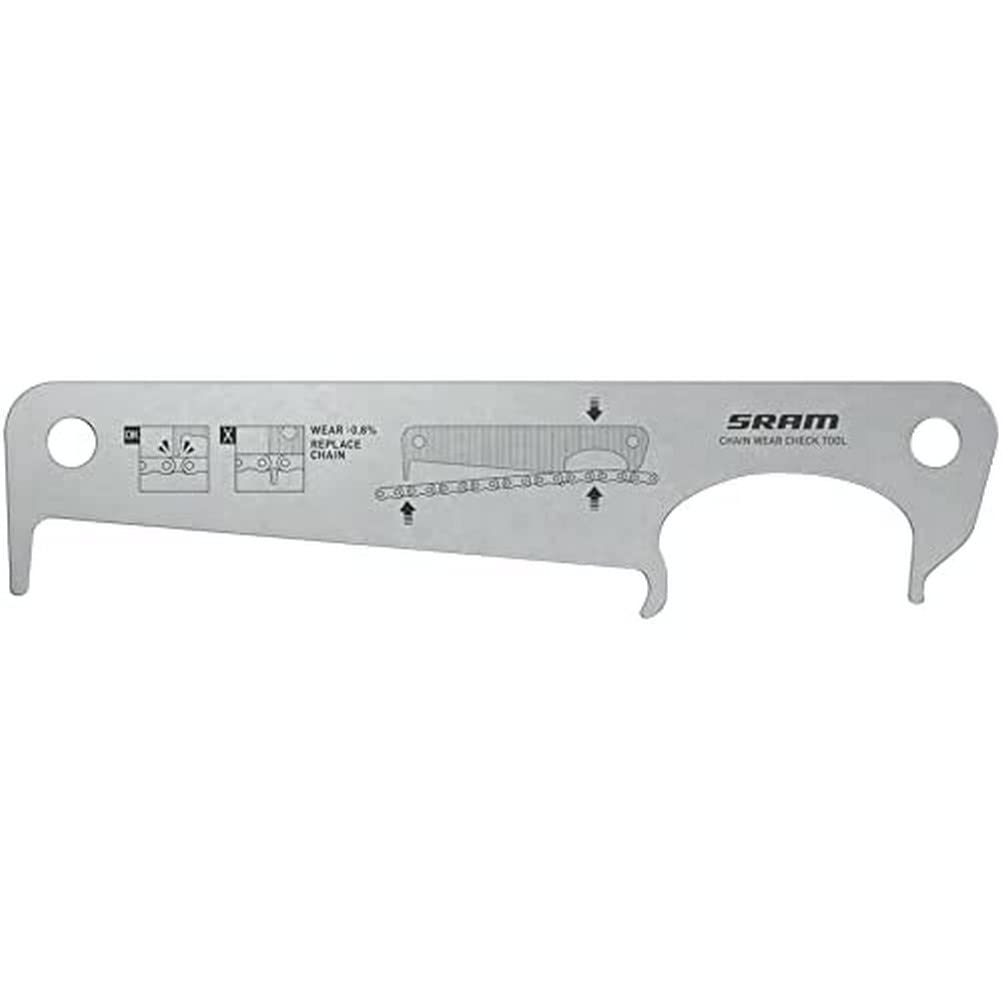
A bicycle chain doesn’t fail all at once — it stretches gradually, link by link, as the metal pins and rollers inside wear down. That gradual elongation is what mechanics call chain wear (sometimes “chain stretch”), and catching it at the right moment is one of the highest-leverage maintenance moves you can make. Swap the chain on time and the rest of your drivetrain — the cassette (the cluster of sprockets at the rear wheel) and the chainring up front — can last two or three chain cycles. Miss the window and the worn chain grinds the cassette teeth into a matching worn profile; now you need to replace everything together, often $300–$600 in parts on a high-end build. The challenge is that not all chains are measured the same way, and the inexpensive tool most cyclists already own isn’t sensitive enough for SRAM’s top-tier AXS groupsets. This article breaks down exactly why, where the numbers diverge, and which tools actually give you reliable data.
Why AXS Tolerances Are Tighter Than You Expect
SRAM’s AXS platform — spanning RED AXS for road and Eagle AXS for mountain — operates around a wireless electronic shifting architecture (the derailleur moves via a small motor triggered by a Bluetooth signal rather than a mechanical cable). The electronics are the headline, but the underlying chain and cassette engineering is equally sophisticated, and it’s where the tolerance story gets consequential.
SRAM’s published service documentation for RED AXS specifies a chain replacement threshold of 0.5% elongation — half the 1.0% limit that’s commonly cited for standard road chains and baked into most generic chain checkers. Eagle AXS transmission chains, used in the newer T-Type drivetrain, operate under a similarly tight replacement window. The reason is geometry: narrower chain-to-cassette clearances, tighter tooth profiles machined into the XS-Ring and X-Sync sprocket designs, and — on the Transmission system — a direct-mount rear derailleur that relies on precise chain tension feedback. A chain that a generic 1% checker calls “fine” may already be beyond SRAM’s own replacement spec. That’s not a marketing footnote — it’s the difference between a $60 chain swap and a $350–$500 cassette replacement.
Per BikeRadar’s long-term coverage of RED AXS, early-adopter mechanics who carried conventional tool habits over from Shimano 11-speed builds ran into premature cassette wear at a rate that surprised them. The pattern across aggregated shop reports is consistent: the gap between “generic tool says acceptable” and “SRAM spec says replace” is real, and it compounds quickly in high-load conditions like steep climbing or heavy riders.
The Problem With Generic Chain Checkers
The standard chain wear checker — the style that drops into the chain links and uses a go/no-go pin to indicate 0.75% or 1.0% elongation — was designed for a drivetrain world where those tolerances were appropriate. For most 10- and 11-speed Shimano and older SRAM systems, checking at 0.75% and replacing by 1.0% is sound practice. The Park Tool CC-2 and the Shimano TL-CN42 both operate on this logic.
But here’s the math that changes the equation:
By the numbers
- Generic checker go/no-go threshold: ~0.75–1.0% elongation
- SRAM RED AXS replacement spec (per SRAM technical documentation): 0.5%
- Eagle AXS T-Type recommended replacement: 0.5%
- Chain cost avoided by timely swap: ~$60–$85
- Cassette replacement cost missed: $180–$500+ depending on RED vs. Eagle
A tool calibrated to flag at 0.75% will let an AXS chain run 50% past its intended replacement point. That’s not a marginal error — it’s a systematic miss. And because AXS cassettes (especially RED’s 10-33 or 10-36 options and Eagle’s 10-52 XD freehub cassettes) sit in the $180–$500 range, the cost asymmetry is severe.
VeloNews’s drivetrain longevity reporting from 2024–2025 flagged this exact pattern, noting that the growth of electronic groupsets across the peloton and in consumer builds had revealed a mismatch between tool stock and new-generation tolerance requirements. The recommendation across their sourced mechanics was consistent: dedicate a 0.5%-capable tool to any AXS build.
Which Tools Actually Hit the 0.5% Mark
There are three credible solutions, sitting at different price points and use cases.
Park Tool CC-4 Chain Checker Park Tool’s CC-4 is designed specifically to read at 0.5% elongation — a direct response to the tightened specs on modern high-end drivetrains. Per Park Tool’s own product documentation, the CC-4 uses a dual-sided measurement system that can read both 0.5% and 0.75% thresholds. For a shop maintaining multiple AXS builds, or a home mechanic with a single high-investment groupset, this is the logical upgrade from the CC-2. Street price as of mid-2026 sits around $25–$35 — negligible relative to the cassette it protects.
Shimano TL-CN42 Despite being a Shimano tool, the TL-CN42 reads at a 0.5% threshold and is chain-agnostic — it works on SRAM chains just as accurately as Shimano’s own. Pricing is typically in the $12–$20 range. It’s a single-threshold tool (no dual-side reading), which means you lose the 0.75% early-warning indicator, but for a cost-conscious setup it covers the critical measurement.
Rohloff Caliber 2 (and similar precision digital gauges) For small-shop mechanics or coaches managing a fleet of high-end bikes, a digital elongation gauge gives per-link precision that no go/no-go tool can match. The Rohloff Caliber 2 is the benchmark in this category — often cited by cyclingnews.com’s technical review team as the shop standard for precision drivetrain work. It runs $60–$80, and the data granularity lets you track a chain’s wear curve across multiple check-ins rather than getting a binary pass/fail. On a $3,000+ groupset investment, understanding the rate of wear — not just the threshold — is legitimately useful.
What to avoid: The sub-$10 single-pin checkers that show up in bulk listings. Per the aggregated pattern across shop reviews, these tools have inconsistent manufacturing tolerances that can themselves introduce error of ±0.1–0.2%, which is meaningful when your target measurement window is only 0.5%. They’re fine for a casual bike; they’re a liability on an AXS build.
Eagle Transmission vs. Classic Eagle: The T-Type Wrinkle
SRAM’s Eagle AXS platform now spans two distinct chain standards, and conflating them is a common source of compatibility errors — even among experienced mechanics.
Classic Eagle AXS (used with the non-Transmission rear derailleur, XD driver freehub) uses the Eagle 12-speed chain. Cassette compatibility follows the XD driver standard. Chain replacement at 0.5% is recommended.
Eagle AXS Transmission (the newer system, with the direct-mount “UDH” Universal Derailleur Hanger and XS-Ring sprockets) uses the Flattop chain — a narrower-profile chain that is not interchangeable with classic Eagle chains. Per SRAM’s published technical documentation on the Transmission system, mixing a Flattop chain with a non-Transmission cassette or vice versa creates indexing errors and accelerated wear. This is a hard compatibility wall, not a preference.
The wear measurement approach is the same (0.5%), but the replacement chain SKU is different. If you’re buying replacement chains for a mixed fleet of Eagle builds, verify the derailleur generation before ordering. The visual tell is the chain profile — Flattop chains have a distinctively flat outer plate compared to the rounded profile of the classic Eagle chain — but the safest verification is the component serial number against SRAM’s compatibility database.
Cycling News’s coverage of the Eagle Transmission launch noted that early-adopter confusion around chain compatibility was the most common service issue reported by mechanics in the first season. That data point has held across subsequent seasons based on shop feedback aggregated in BikeRadar’s drivetrain service roundups.
Building the Right Maintenance Cadence
Knowing the threshold is half the equation. The other half is measurement frequency, because AXS chains can move through their wear window faster than conventional chains under heavy use.
A practical framework based on published manufacturer guidance and shop-operator norms:
- Road RED AXS: Check at every 500–750 km (roughly 300–450 miles), or after any extended wet-weather riding. Wet conditions accelerate abrasion inside the links.
- Eagle AXS (mountain / gravel): Check every 200–300 miles of trail riding, or after every 2–3 muddy rides. Mud infiltration into the chain rollers accelerates internal wear at a rate that makes monthly checking the default for regular riders.
- T-Type Transmission: Same cadence as classic Eagle AXS by use case, but cross-reference against SRAM’s published interval guidance — the XS-Ring tooth geometry is designed to extend cassette life if the chain is replaced on schedule, and it underperforms that promise if the chain runs long.
One useful habit from shop-operator experience: track your check date and odometer in a notes app or a simple paper log taped inside the tool drawer. The failure mode isn’t usually ignorance of the spec — it’s a three-month gap between checks that turns a $70 chain problem into a $450 cassette problem.
If X, Then Y: The Decision Rule
Here’s how to map your situation to the right action:
If you’re running any AXS groupset (RED or Eagle) and your only chain checker is a generic 0.75–1.0% tool: Replace the tool. The Park Tool CC-4 or Shimano TL-CN42 costs less than 10% of one cassette. This is the highest-ROI tool purchase in your kit.
If you manage more than two high-end bikes (shop, coach, or multi-bike household): Add the Rohloff Caliber 2 or equivalent digital gauge. The per-link precision lets you make predictive decisions — “this chain has two rides left” — rather than reactive ones.
If you’re sourcing a replacement chain and aren’t certain which Eagle generation you’re on: Confirm the derailleur type (Transmission = Flattop chain; classic AXS = standard Eagle 12-speed chain) before ordering. Incorrect chain fitment on a Transmission system is not a minor performance issue; it accelerates cassette wear from the first pedal stroke.
If your budget is genuinely tight and you can only own one tool: The Shimano TL-CN42 at $12–$20 hits the 0.5% threshold, works on SRAM chains, and costs less than a nice lunch. There’s no financial argument for running the wrong tool on a $2,000+ drivetrain.
The underlying principle is straightforward: AXS drivetrains are high-precision systems that were engineered to tighter tolerances than the tooling most cyclists already own. Closing that gap is a $20–$80 decision that protects a $300–$500 downstream cost. The math isn’t close.