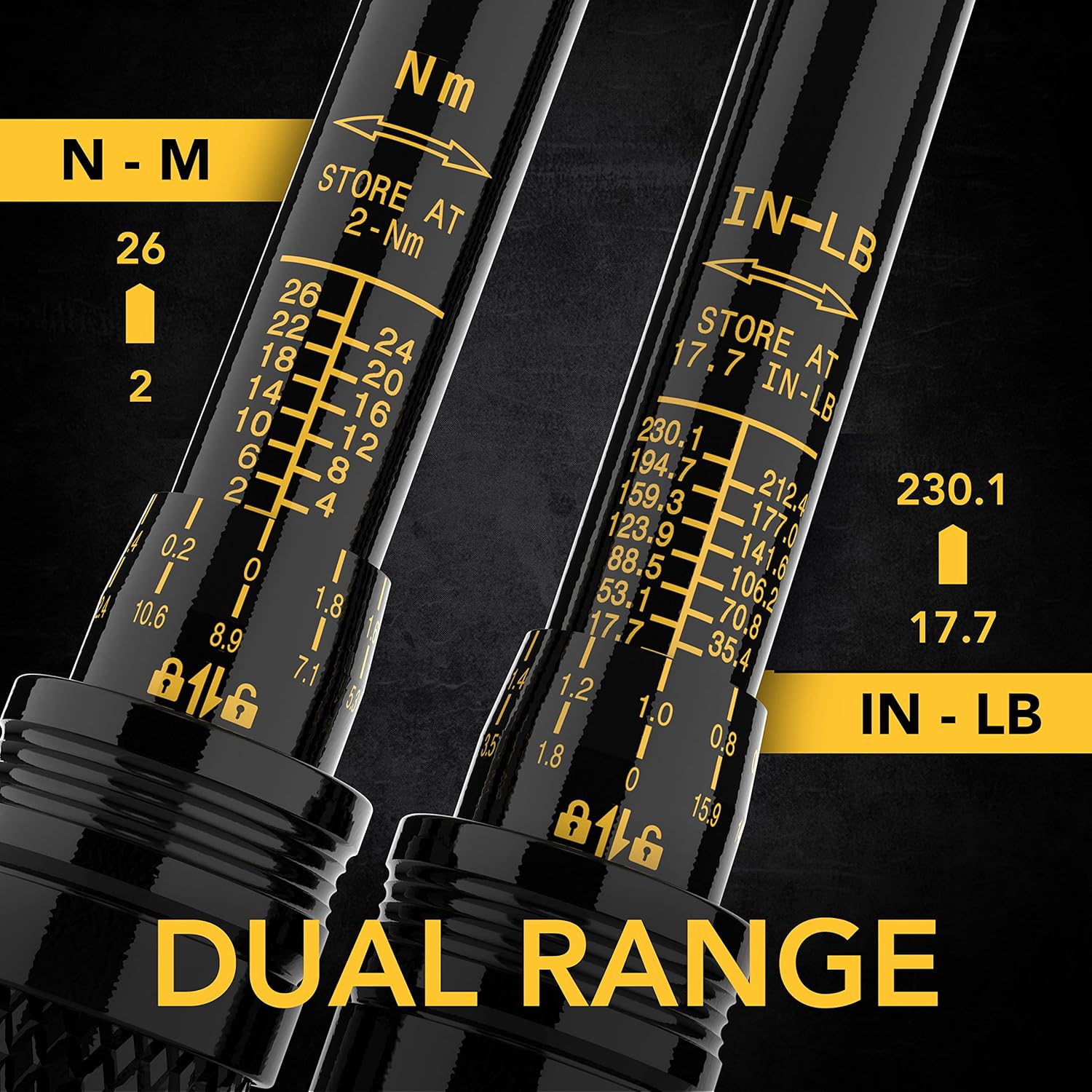
There’s a one-sentence confession buried in reviews of the LEXIVON LX-191 torque wrench that stopped me mid-scroll: a rider admitted to overtightening bolts “even to the point of stripping threads and breaking parts” before finally switching to a torque wrench. If you’ve been wrenching on bikes for any length of time, that sentence probably landed somewhere uncomfortable. Overtightening is the most common home-mechanic mistake, and it’s not a skill gap — it’s a feedback gap. Your hand doesn’t know the difference between 5 Nm and 12 Nm. A torque wrench does. A torque wrench is a precision tool that stops tightening a bolt at a predetermined force (measured in Newton-meters, or Nm), preventing you from going past the limit the component manufacturer designed for. On a steel bike from the 1990s, a few extra foot-pounds rarely mattered. On a modern carbon frame, a $400 carbon seatpost, or a threadless headset, those extra turns can crack the part you were trying to protect.
This guide is for the rider who has at least one stripped bolt in their past — and wants a clear decision framework for choosing the right torque tool going forward. We’ll compare five tools across the use cases that actually matter, show you where the Nm ranges collide and diverge, and end with a decision rule you can apply tonight.
| EDITOR'S PICKFeedback Sports | Mid-tierPark Tool ATD-1.2 - Adjustable… | Budget pickBikeHand Bike Chain Checker Too… | |
|---|---|---|---|
| Range | 2-14 Nm | — | — |
| Includes bits | ✓ | — | — |
| Case included | ✓ | — | — |
| Chain checker | ✗ | ✗ | ✓ |
| Price | $125.00 | $79.95 | $8.99 |
| See on Amazon → | See on Amazon → | See on Amazon → |
Why “Feel” Isn’t a Torque Spec
The reason experienced mechanics still overtighten is that feedback from a hex key is nonlinear. A bolt feels loose, then snug, then suddenly you’ve crossed the yield point of the aluminum threads and you’re in trouble. This is especially true at lower torque values — the 4–6 Nm range where most cockpit bolts, stem faceplate bolts, and carbon seatpost clamps live. At those values, a standard L-shaped hex key gives you almost no tactile signal that you’re approaching spec. You’re relying on experience that’s only calibrated if you’ve been using a torque wrench regularly in the first place.
Per Sheldon Brown’s bicycle repair glossary and workshop notes, carbon fiber components are particularly unforgiving because they don’t deform gradually the way metal does — they fail abruptly. Shimano’s technical documents for Dura-Ace Di2 components specify stem-to-steerer bolts at 5–7 Nm and carbon bar clamps at 5 Nm; SRAM’s Red AXS installation guide similarly calls out torque values in the 4–8 Nm range for most cockpit hardware. These specs exist for a reason, and they’re well within the range where a bare hex key will lie to you.
BikeRadar’s torque wrench buying guide makes the point directly: precision tools aren’t a luxury for high-end bikes, they’re especially necessary for high-end bikes, where the margin between “properly torqued” and “component failure” is narrower and the replacement cost of a mistake is measured in hundreds of dollars.
The Tools: Where Each One Fits
LEXIVON LX-191: The Honest Starting Point
The LEXIVON LX-191 is a click-style torque wrench — meaning it produces an audible click and a tactile release when you hit the set torque value — covering a range typically around 2–24 Nm, which encompasses nearly every bolt on a modern road or mountain bike except pedals and through-axles. The story from that reviewer is the emotional anchor here for a reason: it’s a real-world account of what changes when you add a click wrench to your workflow. Owners consistently report that the click mechanism is noticeably quieter at the lower end of the range (2–4 Nm), which leads some riders to wonder whether the wrench is working correctly at those values.
That quieter click at low settings is normal behavior for click-style torque wrenches. The mechanical release that generates the click has less energy to dissipate at lower preloads, so the sound and feel are subtler. That’s not an accuracy issue — it’s physics. The fix is to stay alert, torque slowly, and stop the moment you feel the joint break rather than waiting for a loud snap. Accuracy concerns are better addressed by checking the wrench against known standards periodically, not by interpreting click volume as a quality signal.
Park Tool ATD-1.2: The Right Tool for the Right Job
The Park Tool ATD-1.2 Adjustable Torque Driver is not a conventional wrench — it’s a preset-style screwdriver-format tool designed specifically for the 1–10 Nm range where most cockpit, brake lever, and small component fasteners live. Park Tool’s own product documentation is explicit about its purpose: fine, precise work on small fasteners where a full-size click wrench would be awkward or provide too little feel for controlled turns.
Reviewers of the ATD-1.2 consistently note it excels exactly where conventional wrenches fail — that low-Nm zone where you’re applying almost no force and a standard hex key tells you nothing. The trade-off is equally clear: this is not a high-torque tool. Reviewers specifically flag that it is not designed for pedal installation (pedals typically spec at 35 Nm on the left and right cranks) or bottom bracket cups. Using it for those jobs will likely damage the tool and won’t give you confidence in the applied torque. Treat the ATD-1.2 as a specialist instrument for your cockpit work, not a do-everything solution.
MARQUE Torque Wrench: Accuracy With a Bit Gap
The MARQUE wrench earns consistent praise for accuracy across aggregated reviews — owners repeatedly call out that it clicks reliably and consistently at stated values, which is the core job. The caveat reviewers flag: the included bit set doesn’t cover all common bike bolt heads. If you’re working across a full modern groupset — Shimano, SRAM, and Campagnolo hardware all live happily on the same workshop bench for some riders — you’ll encounter bolt heads the MARQUE kit doesn’t include out of the box.
The practical fix is to supplement with a quality standalone bit set. That’s a minor spend that doesn’t undermine the tool’s value, but it’s a hidden cost to surface before you’re frustrated mid-job. Budget it in from the start.
LEZYNE Torque Drive: Pro Tip Built In
The LEZYNE Torque Drive is a compact, portable click wrench popular with riders who want to carry torque capability on group rides or travel. The most useful insight from reviewers isn’t about the wrench itself — it’s a usage tip: reserve the LEZYNE Torque Drive only for final torquing, not for loosening bolts.
This applies to nearly all click-style torque wrenches, but the LEZYNE’s size makes it especially tempting to use as a multi-purpose tool. Using a torque wrench to break a stubborn bolt loose applies the click mechanism in reverse under stress, which can damage the calibration over time. Use a standard hex key or breaker bar to loosen, then switch to the torque wrench for final tightening. That single habit change meaningfully extends the life and accuracy of any torque wrench in your kit.
Feedback Sports Range: The Portable Through-Axle Case
The Feedback Sports Range torque wrench earns specific praise in reviews for a real-world use case that’s easy to undervalue: through-axle torquing in a portable context. Reviewers specifically mention using it for through-axle work on a truck bike rack — the kind of situation where you’ve removed a wheel for transport and need to properly reinstall it without your full workshop. Through-axles on modern bikes typically spec at 12–15 Nm (check your frame and fork manufacturer’s documentation), and a torque wrench that travels with you closes the gap between “good enough” and “actually correct.”
By the Numbers: Nm Ranges for Common Bike Fasteners
| Fastener Type | Typical Torque Range | Right Tool Category |
|---|---|---|
| Carbon cockpit bolts, stem faceplate | 4–6 Nm | ATD-1.2 or low-range click wrench |
| Brake lever clamp bolts | 6–8 Nm | Click wrench (mid-range) |
| Through-axles (check OEM spec) | 12–15 Nm | Full-range click wrench |
| Pedal spindles | 35 Nm | Separate pedal wrench — not ATD-1.2 |
The Hidden Cost of Getting It Wrong
A stripped M5 bolt in a carbon steerer isn’t a bolt problem — it’s a frame problem. Helicoil repair inserts, machining time at a specialty shop, and in worst-case scenarios a replacement fork or frame make the $150–$300 cost of a quality torque wrench look very different in hindsight. BikeRadar’s workshop tool coverage consistently frames precision tools as insurance policies, not premiums.
The total cost of ownership math here is straightforward: one stripped carbon component typically costs more to repair than a full torque wrench setup. If your frame, fork, or components are worth more than $500 — and for most readers here they are — a quality torque wrench is not optional equipment.
Frequently Asked Questions
Can I use the MARQUE 4/5/6 Nm wrench for through-axles and pedals? No. Through-axles typically require 12–15 Nm, and pedals require 35 Nm — both well outside a 4–6 Nm wrench’s range. Using a wrench outside its rated range compromises both accuracy and tool integrity. You need a wrench rated to at least 20 Nm for through-axles, and pedals are best handled with a proper pedal wrench plus a torque measurement tool rated above 35 Nm.
Why does the LEXIVON LX-191 click more quietly at lower torque settings — does that mean it’s less accurate? No. The quieter click at 2–4 Nm is a normal mechanical property of click-style torque wrenches — there’s simply less stored energy in the mechanism at low preloads, so the release is subtler. It does not indicate a calibration problem. Slow, controlled application and sensitivity to the joint “breaking” rather than listening for a loud snap will serve you better at these values.
Should I use my torque wrench to loosen bolts or only to tighten them? Only to tighten. Using a click-style torque wrench to break bolts loose puts reverse stress on the click mechanism, which degrades calibration over time. Use a standard hex key to break the bolt free, then use your torque wrench for the final tightening pass. This applies across all click-style tools, including the LEZYNE Torque Drive.
What torque range do I actually need for cockpit bolts vs. pedals vs. through-axles? Cockpit bolts and stem faceplate bolts: 4–8 Nm. Through-axles: typically 12–15 Nm (verify with your frame/fork manufacturer — Shimano’s and SRAM’s technical documents both publish component-specific specs). Pedal spindles: 35 Nm. You likely need at least two tools — a low-range precision driver like the ATD-1.2 for cockpit work, and a full-range click wrench (rated to at least 20–25 Nm) for axle and pedal work.
Is the Park ATD-1.2 sufficient as a standalone torque tool or do I need a supplemental wrench for higher-Nm jobs? Not as a standalone. The ATD-1.2 is purpose-built for 1–10 Nm work and is exceptional in that range. But per Park Tool’s own documentation, it is not designed for high-torque fasteners. If you’re doing any wheel removal, pedal swaps, or bottom bracket work, you need a supplemental wrench rated for those higher values. Think of the ATD-1.2 as your cockpit specialist and pair it with a full-range click wrench for everything else.
The Decision Rule
If your primary pain point is cockpit bolts, carbon seatposts, and stem hardware on a modern road or gravel bike: start with the Park ATD-1.2 as your precision low-Nm tool, and pair it with a click wrench covering up to 25 Nm for axle and pedal work.
If you want one tool that handles most of your bike’s fastener range: the LEXIVON LX-191 or the MARQUE wrench (supplemented with a complete bit set) covers 2–24 Nm and handles everything except pedals.
If you ride with wheel removal on the road or at a trailhead: the Feedback Sports Range belongs in your travel kit for through-axle reinstallation.
If tool longevity matters to you: regardless of which wrench you choose, never use it to loosen bolts. That single habit protects your calibration and extends the tool’s useful life for years.
The mechanic who stripped threads and broke parts wasn’t careless — they were working without feedback. A click wrench doesn’t make you a better mechanic. It gives you the information your hands never had.